Difference Between KSE-100 and KMI-30: Which Index Should Investors Understand?
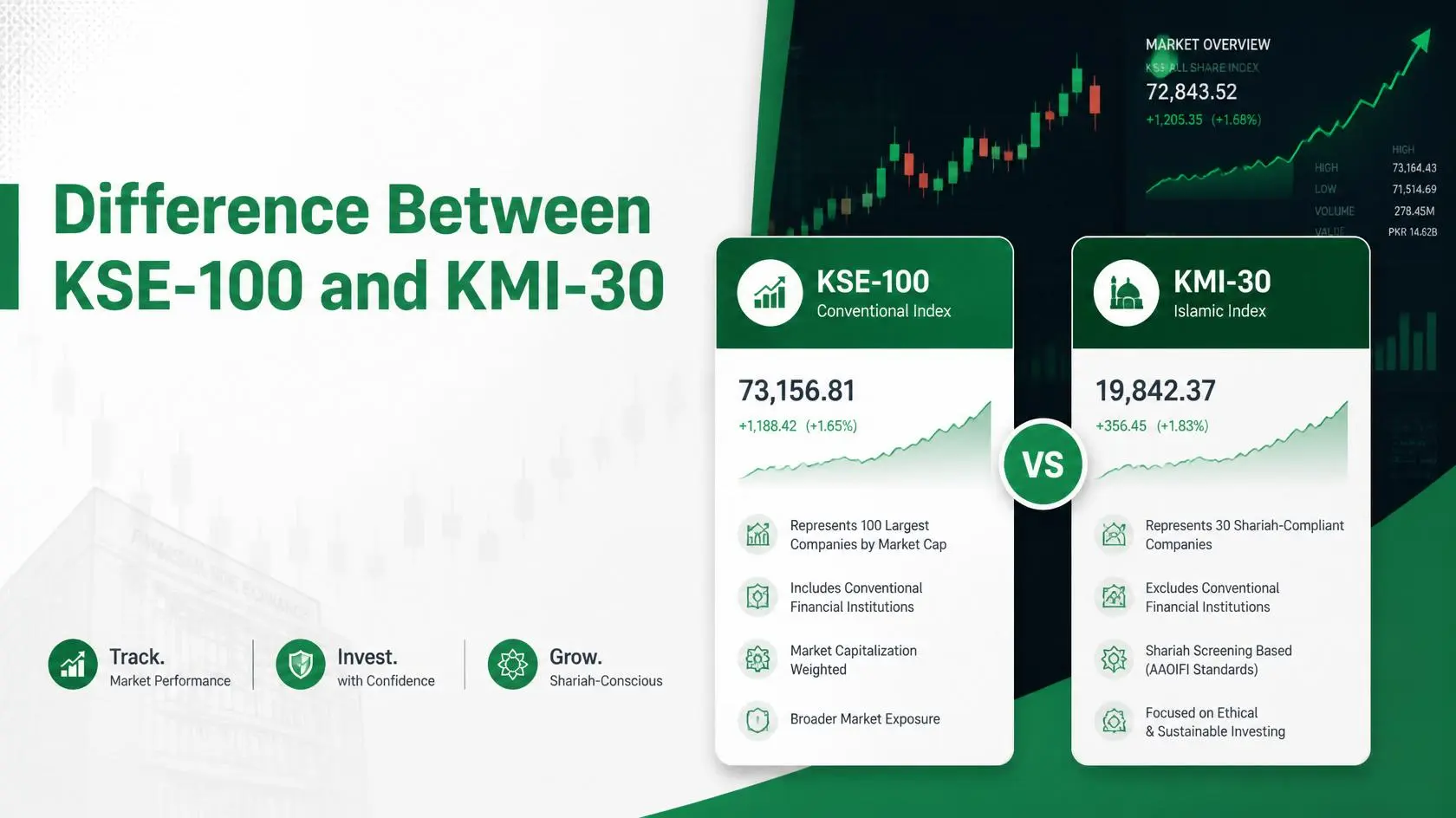
If you've recently started learning about the Pakistan Stock Exchange (PSX), you've probably come across two important market indices: KSE-100 and KMI-30.
While both measure the performance of selected listed companies, they serve different purposes and are designed for different types of investors.
Understanding the difference between these indices will help you better interpret market news, analyze trends, and choose investments that align with your financial goals and, where applicable, your preference for Shariah-compliant investing.
What Is a Stock Market Index?
A stock market index tracks the performance of a selected group of listed companies.
Indices help investors understand:
- Overall market direction
- Sector performance
- Investor sentiment
- Historical market trends
- Benchmark investment performance
Instead of analyzing hundreds of listed companies individually, investors often use indices as a quick snapshot of the market.
What Is the KSE-100 Index?
The KSE-100 Index is the benchmark index of the Pakistan Stock Exchange.
It represents 100 selected companies from different sectors based on market capitalization and sector representation.
Its purpose is to reflect the overall performance of Pakistan's equity market.
Key Features
- Benchmark index of the PSX
- Includes companies from multiple sectors
- Represents a large portion of total market capitalization
- Widely followed by investors, analysts, and financial media
What Is the KMI-30 Index?
The KMI-30 Index consists of 30 companies that meet recognized Shariah compliance screening criteria and liquidity requirements.
It is designed for investors seeking exposure to companies that comply with Islamic investing principles.
Key Features
- Focuses on Shariah-compliant companies
- Contains 30 selected stocks
- Reviewed periodically
- Used as a benchmark for Islamic equity investing
KSE-100 vs KMI-30
| Feature | KSE-100 | KMI-30 |
|---|---|---|
| Number of Companies | 100 | 30 |
| Purpose | Broad market benchmark | Shariah-compliant benchmark |
| Includes Conventional Financial Companies | Yes | No |
| Shariah Screening | Not required | Required |
| Investor Focus | General investors | Shariah-conscious investors |
Which Index Is Better?
Neither index is inherently "better."
The right choice depends on your investment objectives.
You may prefer the KSE-100 if you want a broad overview of the Pakistan Stock Exchange.
You may prefer the KMI-30 if you want to focus on companies that satisfy recognized Shariah screening criteria.
Why Investors Should Monitor Both
Even if your portfolio focuses on Shariah-compliant investments, understanding the broader market provides valuable context.
Monitoring both indices can help you:
- Understand overall market direction.
- Compare Shariah-compliant stocks with the wider market.
- Identify sector trends.
- Improve long-term investment research.
Common Misconceptions
"The KMI-30 always outperforms the KSE-100."
Not necessarily. Performance varies depending on market conditions and sector leadership.
"Every company in the KSE-100 is Shariah compliant."
No. The KSE-100 includes companies regardless of Shariah status.
"The KMI-30 never changes."
Incorrect. Its constituents are reviewed periodically based on established criteria.
Key Takeaways
- The KSE-100 is the primary benchmark index of the Pakistan Stock Exchange.
- The KMI-30 tracks selected Shariah-compliant companies.
- Both indices serve different purposes.
- Understanding both helps investors make better-informed decisions.
- Choose investments based on research, risk tolerance, and financial objectives.
Frequently Asked Questions
What does KSE-100 represent?
The KSE-100 represents 100 selected companies and is widely used as the benchmark index of the Pakistan Stock Exchange.
Is every KMI-30 company Shariah compliant?
The index includes companies that meet recognized Shariah screening criteria at the time of review.
Which index should beginners follow?
Beginners benefit from understanding both. The KSE-100 provides a broad market view, while the KMI-30 is particularly relevant for investors seeking Shariah-compliant investments.
Conclusion
The KSE-100 and KMI-30 are both valuable tools for understanding the Pakistan Stock Exchange. Knowing how they differ allows investors to interpret market movements more effectively and build investment strategies that align with their financial goals and investing principles.
Educational Disclaimer: This article is for educational purposes only and should not be considered investment or financial advice. Index composition and methodology may change over time. Always verify the latest information from official sources before making investment decisions.