Gold vs Stocks vs Forex: Understanding the Difference
Introduction
Investors often hear about gold, stocks and forex as ways to participate in financial markets.
But these markets are fundamentally different.
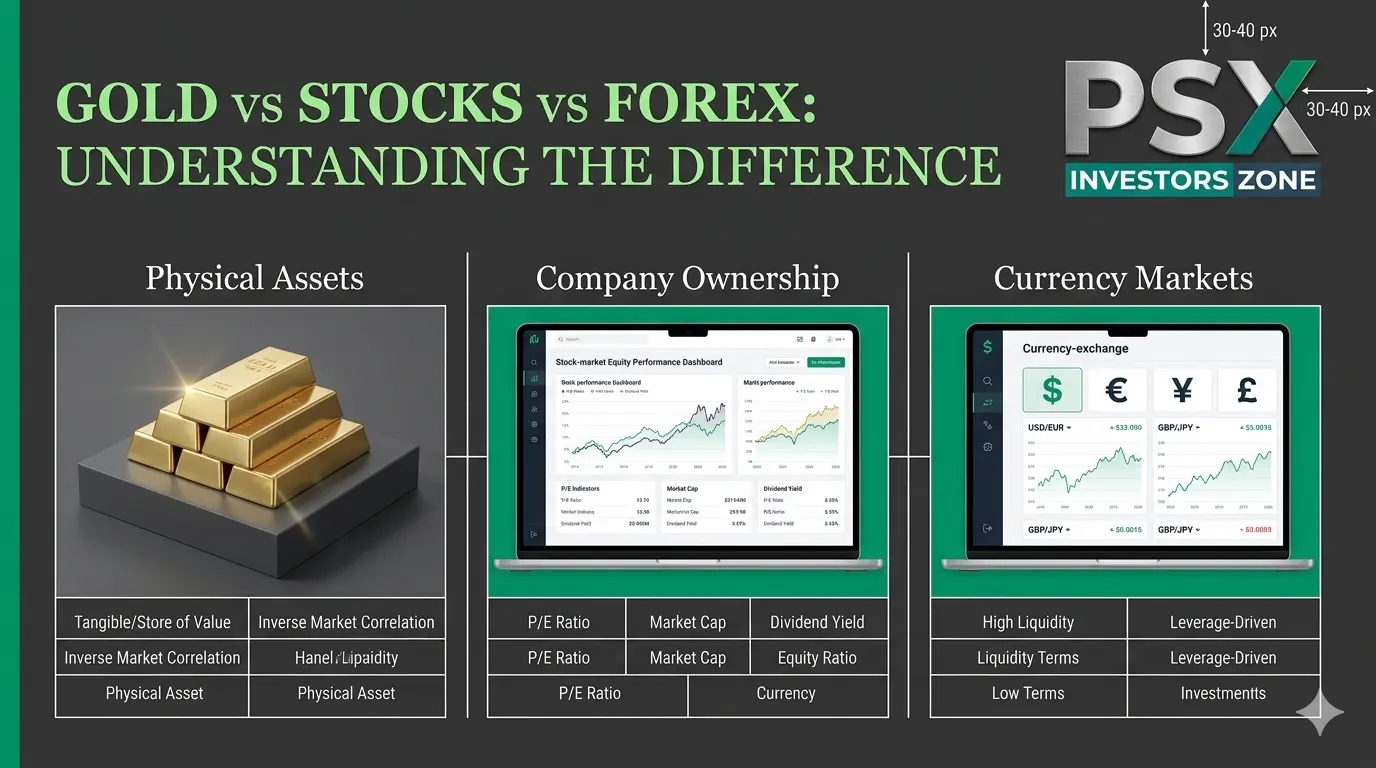
Gold represents a precious metal and is often viewed as a store of value or portfolio diversification asset.
Stocks represent ownership in companies.
Forex, short for foreign exchange, involves trading one currency against another.
Understanding these differences is important before deciding where your money should go.
For investors in Pakistan, the choice can become even more important because each market has different:
- Risk levels
- Return characteristics
- Trading structures
- Costs
- Liquidity
- Investment horizons
- Sources of returns
This guide explains the key differences between gold, stocks and forex in simple terms.
Important: This article is for educational purposes only. It does not recommend any specific investment, stock, currency pair or gold product and does not guarantee profits.
What Is Gold?
Gold is a precious metal that has been used as a store of value for thousands of years.
Investors can gain exposure to gold through different forms, including:
- Physical gold
- Gold bars
- Gold coins
- Gold jewelry
- Gold-backed investment products
Gold does not represent ownership in a company.
When you own physical gold, your return generally comes from changes in its market price.
Unlike a company stock, gold does not generate business profits.
What Are Stocks?
Stocks represent ownership in publicly traded companies.
When you buy shares of a company listed on the Pakistan Stock Exchange (PSX), you become a shareholder.
Your potential return can come from:
Capital Appreciation
The share price increases.
Dividends
The company distributes part of its earnings to shareholders, subject to its dividend policy and available cash.
For long-term investors, stocks can provide exposure to the growth of businesses and the broader economy.
What Is Forex?
Forex means foreign exchange.
It is the global market where currencies are exchanged.
Examples of currency pairs include:
- USD/PKR
- EUR/USD
- GBP/USD
- USD/JPY
In forex, one currency is traded against another.
If you buy USD/PKR, you are effectively taking a position on the relative value of the US dollar against the Pakistani rupee.
Forex markets are heavily influenced by:
- Interest rates
- Inflation
- Central-bank policy
- Economic growth
- Political developments
- Geopolitical events
- Currency flows
Gold vs Stocks vs Forex at a Glance
| Feature | Gold | Stocks | Forex |
|---|---|---|---|
| What you own/trade | Precious metal | Company ownership | Currency position |
| Main return source | Price appreciation | Price appreciation + dividends | Currency price movement |
| Income generation | No operating income | Possible dividends | Generally no dividend-like company income |
| Typical use | Diversification/store of value | Long-term wealth creation | Currency exposure/trading |
| Trading hours | Depends on market/product | Exchange hours | Global market, near 24-hour weekdays |
| Volatility | Can be significant | Varies by company | Can be high |
| Leverage | Product-dependent | Usually lower for direct shares | Commonly available |
| Ownership of business | No | Yes | No |
| Business earnings matter | No | Yes | No |
| Main fundamental drivers | Rates, inflation, demand, geopolitics | Earnings, growth, valuation | Rates, inflation, economic conditions |
How Do You Make Money From Gold?
Gold investors generally benefit when the price of gold increases.
For example:
You buy gold at:
Rs. 250,000
Later, its value rises to:
Rs. 280,000
Your gross price gain is:
Rs. 30,000
However, actual returns can be affected by:
- Buying premium
- Selling spread
- Dealer charges
- Storage
- Taxes
- Purity
- Form of gold
Gold itself does not generate business earnings or dividends.
How Do You Make Money From Stocks?
Stocks can provide two major potential sources of return.
1. Capital Appreciation
You buy a stock at:
Rs. 100
and later sell it at:
Rs. 130
Your gross capital gain is:
Rs. 30 per share
2. Dividends
If the company distributes:
Rs. 5 per share
your total return before costs and taxes could include:
Rs. 30 capital gain + Rs. 5 dividend
Stocks therefore have a unique characteristic compared with gold:
You can participate in the economic growth of an underlying business.
How Do You Make Money From Forex?
Forex returns generally come from changes in exchange rates.
Suppose you take a position based on:
USD/PKR = 280
If the exchange rate later moves to:
USD/PKR = 290
a correctly positioned trader may benefit from the price movement.
However, the opposite movement can produce losses.
Forex trading can involve substantial risk, particularly when leverage is used.
Gold vs Stocks: The Major Difference
The biggest difference is the underlying asset.
Gold
You are exposed to the value of a precious metal.
Stocks
You own an interest in a business.
This means stock investors can analyze:
- Revenue
- Earnings
- Cash flow
- Debt
- Management
- Competitive advantage
- Valuation
Gold investors instead focus more on factors such as:
- Inflation
- Interest rates
- Real yields
- Central-bank demand
- Currency movements
- Global risk
- Supply and demand
Gold vs Forex: The Major Difference
Gold is a physical commodity.
Forex is a currency market.
Gold can be held physically.
Forex is generally traded through financial accounts or market instruments.
Gold's price can be influenced by monetary conditions and geopolitical uncertainty.
Forex is primarily about the relative value of one currency against another.
Stocks vs Forex: The Major Difference
Stocks represent ownership.
Forex does not give you ownership of a company.
When buying a stock, investors can benefit from:
- Business growth
- Earnings growth
- Dividends
- Increasing intrinsic value
Forex trading focuses on currency-price movements.
This makes the analytical framework very different.
Which Has More Risk: Gold, Stocks or Forex?
There is no universal risk ranking.
Risk depends on:
- Asset
- Time horizon
- Position size
- Market conditions
- Leverage
- Diversification
- Entry price
- Strategy
However, leveraged forex trading can create particularly large losses relative to the amount of capital deposited.
Individual stocks can also be highly volatile, especially smaller companies.
Gold can experience significant price declines as well.
The important lesson is:
Never judge risk solely by the asset name.
Why Forex Leverage Matters
Leverage allows a trader to control a larger position with a smaller amount of capital.
For example, if a trading platform provides leverage, a relatively small market movement can create a disproportionately large gain or loss.
This can make forex trading much more dangerous for inexperienced participants.
A market does not need to move dramatically to create a significant leveraged loss.
Stocks and Leverage
Buying ordinary shares with your own cash is fundamentally different from leveraged trading.
If you purchase:
100 shares × Rs. 100 = Rs. 10,000
you have invested Rs. 10,000.
If the stock falls 20%, the market value becomes approximately:
Rs. 8,000
before considering costs.
There is no automatic multiplication of the loss simply because the position is large.
Margin financing and other leveraged products can introduce additional risks.
Gold and Leverage
Gold exposure can also be leveraged through certain financial products.
Therefore, it is incorrect to assume that gold is automatically low-risk.
Physical gold and leveraged gold trading have very different risk profiles.
Always distinguish between:
Owning an asset
and
Trading a leveraged financial instrument based on that asset.
Which Market Is Better for Long-Term Investing?
The answer depends on your objectives.
For long-term investors seeking participation in business growth, diversified stocks can be attractive because companies can:
- Increase revenue
- Increase profits
- Pay dividends
- Expand operations
- Reinvest capital
Gold may serve a different role, such as diversification or wealth preservation.
Forex is generally more associated with active currency trading and speculation rather than traditional long-term ownership.
Your investment horizon and risk tolerance should therefore determine the approach.
Gold as a Diversification Asset
Gold can potentially diversify a portfolio because its price drivers differ from those of individual businesses.
Investors may consider gold when they want exposure to:
- Precious metals
- Inflation concerns
- Currency uncertainty
- Global risk
However, diversification does not eliminate losses.
Gold can also experience prolonged periods of weak performance.
Stocks as a Wealth-Building Asset
Stocks can provide exposure to productive businesses.
A successful company can potentially:
- Increase sales
- Improve margins
- Generate cash
- Expand market share
- Pay dividends
- Reinvest profits
Over long periods, business growth can translate into shareholder value.
But individual stocks can also fail.
This is why diversification and fundamental research matter.
Forex as an Active Trading Market
Forex is often approached differently from long-term stock investing.
Traders may use:
- Technical analysis
- Economic data
- Interest-rate expectations
- Central-bank announcements
- Price patterns
- Risk-management systems
The objective is generally to profit from currency-price movements.
This requires a different skill set from analyzing company financial statements.
Fundamental Analysis: Stocks vs Gold vs Forex
Fundamental analysis looks different across the three markets.
Stock Analysis
Investors can examine:
- Revenue
- EPS
- ROE
- ROA
- Free cash flow
- Debt
- Valuation
- Dividends
Gold Analysis
Investors may examine:
- Interest rates
- Real yields
- Inflation
- Central-bank purchases
- US dollar strength
- Global demand
- Geopolitical risk
Forex Analysis
Traders may examine:
- Central-bank policy
- Interest-rate differentials
- Inflation
- GDP growth
- Employment
- Trade balances
- Political developments
Liquidity Differences
Liquidity refers to how easily an asset can be bought or sold without significantly affecting its price.
Major forex markets are extremely liquid.
Large gold markets can also provide substantial liquidity.
Stock liquidity varies significantly between companies.
Large, actively traded PSX stocks may be easier to buy and sell than thinly traded smaller stocks.
Liquidity should therefore be considered when selecting an investment.
Price Volatility
Volatility measures how much prices fluctuate.
Gold
Can experience significant moves during major economic or geopolitical events.
Stocks
Volatility varies greatly between companies and sectors.
Forex
Currency pairs can move rapidly around major economic announcements.
Higher volatility creates both opportunities and risks.
Costs Matter
Your actual investment return is not simply:
Selling Price − Buying Price
Costs can include:
Gold
- Dealer spread
- Making charges
- Storage
- Taxes
Stocks
- Brokerage
- Exchange-related charges
- Taxes
- Other transaction costs
Forex
- Spread
- Commission
- Swap/financing charges
- Potential leverage-related costs
Always calculate the net return after relevant costs.
Gold, Stocks and Forex in Pakistan
For Pakistani investors, currency risk adds another dimension.
The value of international assets can be affected by movements in:
PKR vs USD
For example, an overseas asset may remain unchanged in dollar terms while its value in rupees changes because the exchange rate moves.
This is especially important when comparing domestic PSX investments with foreign assets.
Shariah Considerations
For investors who follow Shariah principles, the three categories should not automatically be treated as equivalent.
Stocks
A stock may be considered Shariah-compliant depending on:
- Business activity
- Financial ratios
- Interest-related income
- Applicable screening methodology
Investors should verify the latest Shariah screening status.
Gold
Gold investment has specific Shariah considerations depending on the structure of the transaction, ownership, possession and settlement.
Forex
Forex transactions have additional Shariah considerations, particularly regarding:
- Immediate exchange
- Settlement
- Interest
- Leverage
- Swap charges
- Contract structure
Therefore, Shariah-conscious investors should consult qualified scholars or reliable Shariah-screening resources before entering these markets.
Which Is Better for Beginners?
Beginners should first understand the market before committing capital.
For someone interested in long-term investing, learning how to analyze businesses may provide a more structured starting point than attempting highly leveraged short-term trading.
Before investing, understand:
- How the asset works
- How returns are generated
- What can cause losses
- What fees apply
- How liquid the market is
- Whether leverage is involved
- Whether the investment meets your Shariah requirements
Knowledge should come before capital.
Gold vs Stocks vs Forex: A Simple Example
Imagine you have:
Rs. 1,000,000
You could approach the markets very differently.
Gold
You purchase physical gold based on the prevailing market price.
Your return depends primarily on changes in gold's value, after costs.
Stocks
You purchase shares in several companies.
Your return can come from:
- Share-price appreciation
- Dividends
Forex
You place currency positions.
Your return depends on currency movements and can be significantly affected by leverage and transaction costs.
The same Rs. 1 million can therefore have completely different risk characteristics depending on how it is deployed.
Don't Compare Returns Without Comparing Risk
Suppose:
Investment A returns 20%
Investment B returns 12%
It may be tempting to say Investment A is better.
But what if Investment A involved extreme leverage while Investment B involved diversified long-term ownership?
Return must always be considered alongside:
- Risk
- Volatility
- Drawdown
- Liquidity
- Leverage
- Costs
- Time horizon
A higher potential return usually comes with a different risk profile.
Common Mistakes
Mistake 1: Treating All Markets the Same
Gold, stocks and forex have different structures.
Mistake 2: Using Leverage Without Understanding It
Leverage can magnify losses.
Mistake 3: Comparing Gross Returns
Transaction costs can materially reduce actual returns.
Mistake 4: Ignoring Currency Risk
Pakistani investors should consider PKR movements when investing internationally.
Mistake 5: Chasing Short-Term Gains
Past price movements do not guarantee future performance.
Mistake 6: Ignoring Shariah Requirements
Different financial instruments have different Shariah considerations.
A Simple Decision Framework
Before choosing between gold, stocks and forex, ask:
1. What Is My Objective?
Wealth creation, diversification, capital preservation or active trading?
2. What Is My Time Horizon?
Days, months or years?
3. Can I Handle Volatility?
Understand your ability to tolerate losses.
4. Am I Using Leverage?
If yes, understand the full downside before proceeding.
5. What Are the Costs?
Calculate spreads, brokerage, commissions and other charges.
6. Does It Fit My Shariah Requirements?
If you follow Shariah principles, verify the structure and screening requirements.
7. Do I Understand the Asset?
Never invest in something you cannot explain.
Key Takeaways
- Gold, stocks and forex are fundamentally different markets.
- Gold represents exposure to a precious metal.
- Stocks represent ownership in companies.
- Forex involves trading one currency against another.
- Stocks can generate returns through capital appreciation and dividends.
- Gold generally relies on price appreciation rather than business earnings.
- Forex returns depend primarily on currency-price movements.
- Leverage can significantly increase forex trading risk.
- Stock risk varies considerably between companies.
- Physical gold and leveraged gold products have very different risk profiles.
- Pakistani investors should consider currency risk when comparing international investments.
- Transaction costs can materially affect actual returns.
- Shariah considerations differ across gold, stocks and forex.
- The best choice depends on your objective, time horizon, risk tolerance and investment structure.
Frequently Asked Questions
Is gold better than stocks?
Not universally. Gold and stocks serve different purposes. Stocks provide ownership in businesses and potential dividends, while gold primarily provides exposure to a precious metal.
Is forex safer than stocks?
Not necessarily. Forex can involve significant volatility and leverage, which can magnify losses.
Which is better for long-term wealth creation?
Diversified stock investing can provide exposure to long-term business growth, but the appropriate approach depends on the investor's objectives, risk tolerance and valuation discipline.
Can gold generate passive income?
Physical gold generally does not generate dividends or operating income. Returns primarily come from changes in its market price.
Why is forex different from stock investing?
Stock investing involves ownership in businesses. Forex trading involves positions on relative currency values.
Can Pakistani investors invest in all three?
Access depends on the specific product, broker, regulations and account structure. Investors should verify applicable Pakistani laws and the legitimacy of the platform before transferring funds.
Is forex Shariah-compliant?
The answer depends on the specific transaction structure. Issues such as interest, settlement, leverage and swap charges can affect Shariah compliance. Qualified Shariah guidance should be obtained for a specific product.
Should beginners use leverage?
Beginners should understand that leverage can magnify both gains and losses. It should not be used simply because it is available.
Conclusion
Gold, stocks and forex may all appear on financial-market discussions, but they represent very different ways of participating in markets.
Gold provides exposure to a precious metal.
Stocks provide ownership in businesses.
Forex provides exposure to changes in relative currency values.
The right choice depends on what you are trying to achieve.
For long-term investors interested in building wealth through productive businesses, stock investing offers a fundamentally different opportunity from trading currencies or holding gold.
For diversification, gold may play a different role.
Forex requires an understanding of currency markets, macroeconomic factors and, particularly, the risks associated with leverage.
For Pakistani investors, the decision should also consider:
Risk + Time Horizon + Liquidity + Costs + Currency Exposure + Shariah Requirements
The goal should not be to chase whichever market has recently performed best.
Instead, understand the asset, understand the risks and choose an approach that matches your long-term financial objectives.
Educational Disclaimer: This article is for educational and informational purposes only and does not constitute financial, investment, legal, tax or Shariah advice. Investing and trading involve risk, including possible loss of capital. Gold prices, stock prices and currency markets can be volatile. Always conduct your own research and verify the latest regulatory, market and Shariah information before making financial decisions.