How Does PSX Work? A Beginner's Guide to the Pakistan Stock Exchange
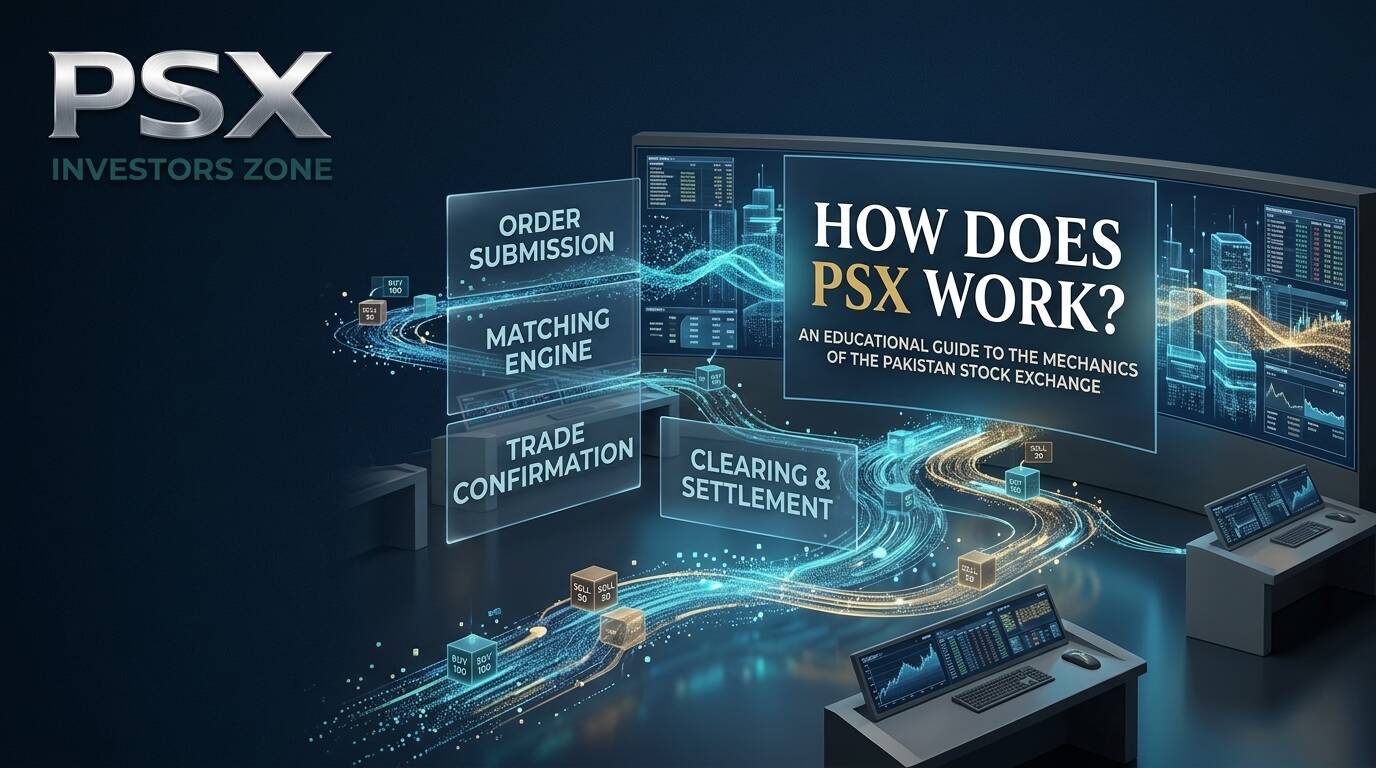
If you are new to investing in Pakistan, understanding how the Pakistan Stock Exchange (PSX) works is one of the most important first steps.
Many beginners see stock prices moving up and down but do not understand what happens behind the scenes when they buy or sell a share.
Who executes the trade?
Where does the share go?
How is the transaction settled?
What role does a stock broker play?
What are CDC and NCCPL?
This guide explains the PSX process in simple terms so beginners can understand how the Pakistan stock market operates.
At PSX Investors Zone, our goal is to make PSX education easier and help investors develop a disciplined approach to investing, including Shariah-compliant investment principles.
What Is PSX?
PSX stands for Pakistan Stock Exchange.
It is Pakistan's primary stock exchange where securities, including shares of listed companies, are traded according to established market rules and regulations.
When a company is listed on PSX, investors can buy and sell its shares through the market infrastructure.
The basic idea is:
Companies raise capital → Shares are listed → Investors trade shares → Market prices are determined → Trades are cleared and settled
How Does PSX Work?
At a basic level, the PSX ecosystem involves several participants and institutions working together.
A simplified process looks like this:
Investor → Broker → PSX Trading System → Trade Execution → Clearing → Settlement → Securities/Cash Accounts
Each part has a specific role.
Understanding these roles makes the stock-market process much easier to understand.
Step 1: A Company Becomes Listed
Before investors can normally trade a company's shares on PSX, the company must meet the applicable listing and regulatory requirements.
A company may decide to raise capital from investors through an initial public offering (IPO) and become publicly listed.
Once its shares are listed, eligible investors can trade them in the secondary market.
The company receives capital through the relevant issuance process, while investors receive shares representing ownership.
Step 2: An Investor Opens an Account
A beginner who wants to invest in PSX generally needs to complete the applicable account-opening requirements and use a licensed securities broker.
The broker provides access to the market and allows investors to place orders.
Depending on the account structure, investors may also have relevant securities and settlement accounts connected with the capital-market infrastructure.
Before opening an account, compare:
- Broker's regulatory status
- Trading platform
- Brokerage charges
- Customer support
- Research tools
- Account security
- Ease of deposits and withdrawals
Do not select a broker solely because someone recommends it online.
Step 3: The Investor Deposits Funds
Once the required account setup is complete, an investor can fund the account through the applicable banking and brokerage procedures.
The available funds determine how much an investor can purchase, subject to the broker's rules and applicable regulations.
Investors should never invest money they cannot afford to lose.
Step 4: The Investor Researches a Stock
Before placing an order, a disciplined investor should research the company.
Consider:
- What does the company do?
- How does it make money?
- Is revenue growing?
- Is EPS growing?
- Is cash flow healthy?
- How much debt does it have?
- What is its valuation?
- What are the major business risks?
For Shariah-conscious investors, also verify the latest applicable Shariah screening status and methodology.
Step 5: The Investor Places a Buy or Sell Order
Suppose you decide to purchase shares.
You enter an order through your broker's trading platform.
Common order information can include:
- Company/security
- Buy or sell
- Number of shares
- Price
- Order type
For example:
Buy 500 shares at Rs. 100 per share
This does not necessarily mean the transaction will immediately happen.
A matching seller must be available according to the market's trading and matching rules.
Step 6: The Market Matches Buyers and Sellers
The PSX trading system facilitates the matching of eligible buy and sell orders according to its rules.
For a transaction to occur, compatible orders need to meet the applicable matching conditions.
For example:
Buyer: Willing to buy at Rs. 100
Seller: Willing to sell at Rs. 100
When the relevant orders are matched, a trade occurs.
This is one of the fundamental mechanisms through which market prices are discovered.
Step 7: The Trade Is Executed
Once a buy and sell order are successfully matched, the transaction is executed.
At this point, the buyer has agreed to purchase the shares and the seller has agreed to sell them under the executed trade terms.
However, the process does not necessarily end at execution.
The trade still has to go through the applicable clearing and settlement process.
Step 8: Clearing Takes Place
After trades are executed, clearing processes determine the obligations of the relevant parties.
This is where the market's post-trade infrastructure becomes important.
The National Clearing Company of Pakistan Limited (NCCPL) plays an important role in clearing and settlement-related functions within Pakistan's capital market.
In simple terms:
Trading = Finding and executing the transaction
Clearing = Determining what each party owes
Settlement = Completing the exchange of securities and funds
Step 9: Settlement Takes Place
Settlement is the process through which the obligations created by the trade are completed.
The buyer provides the required funds and receives the securities according to the applicable settlement process.
The seller delivers the securities and receives the corresponding funds.
The exact settlement cycle and procedures can change according to applicable market rules and regulations, so investors should refer to current official information.
What Is CDC?
The Central Depository Company of Pakistan Limited (CDC) provides central securities depository services for Pakistan's capital market.
In simple terms, CDC is part of the infrastructure that enables securities to be held and transferred electronically.
Instead of relying on physical share certificates, securities can be maintained electronically through the relevant account arrangements.
What Is NCCPL?
The National Clearing Company of Pakistan Limited (NCCPL) is an important part of Pakistan's post-trade market infrastructure.
It performs functions related to clearing and settlement and helps determine obligations arising from trades.
A simple way to remember the difference is:
PSX → Trading
NCCPL → Clearing and settlement functions
CDC → Securities depository and custody infrastructure
The institutions have distinct responsibilities within the overall market system.
What Does a Stock Broker Do?
A stock broker acts as an intermediary between investors and the securities market.
Depending on the services provided, a broker may allow investors to:
- Place buy orders
- Place sell orders
- View market information
- Monitor positions
- Access account statements
- Receive research or market information
Investors should use appropriately licensed and regulated market participants.
How Is a Stock Price Determined?
Stock prices are primarily determined through market supply and demand.
If buying interest increases, buyers may be willing to pay higher prices.
If selling pressure increases, sellers may accept lower prices.
However, the reasons behind buying and selling can be complex.
Stock prices can be influenced by:
- Company earnings
- Dividends
- Economic growth
- Interest rates
- Inflation
- Currency movements
- Government policies
- Industry conditions
- Global markets
- Investor sentiment
- Company announcements
Therefore, a stock's daily price movement does not necessarily tell you whether the underlying business has become better or worse.
What Happens When You Buy a Share?
Suppose you purchase 100 shares of a company.
After the relevant trade and settlement processes are completed, those securities are reflected in the applicable investor securities account structure.
You now have an ownership interest represented by those shares.
Your investment value changes as the market price changes.
For example:
100 shares × Rs. 100 = Rs. 10,000
If the market price later becomes Rs. 120:
100 shares × Rs. 120 = Rs. 12,000
The market value has increased by Rs. 2,000 before considering transaction costs, taxes, and other applicable charges.
But if the price falls to Rs. 80:
100 shares × Rs. 80 = Rs. 8,000
The market value has decreased by Rs. 2,000.
This demonstrates an important principle:
Stock-market returns are not guaranteed.
How Do Investors Make Money on PSX?
There are two common potential sources of return.
Capital Appreciation
An investor may make a capital gain if a share is sold for more than its purchase price, before applicable costs and taxes.
Example:
Buy at Rs. 100 → Sell at Rs. 130
Potential price gain:
Rs. 30 per share
However, the opposite can also happen.
Buy at Rs. 100 → Sell at Rs. 70
Potential loss:
Rs. 30 per share
Dividends
Companies may distribute part of their earnings to shareholders as dividends.
For example, if a company declares Rs. 5 per share and you own 1,000 shares:
1,000 × Rs. 5 = Rs. 5,000
This is the gross dividend amount before applicable taxes and other considerations.
Dividends are not guaranteed.
What Are Trading Hours?
PSX operates according to officially established trading schedules and market sessions.
Trading hours and market procedures can change, so investors should always check the latest official PSX trading schedule rather than relying on outdated information.
Understanding the trading session is important because an order placed outside the relevant trading conditions may be handled differently depending on the market session and order rules.
What Are Market Orders and Limit Orders?
The exact order types available can depend on the broker and market rules, but two commonly understood concepts are:
Market Order
An order to buy or sell at the available market price according to the applicable order-matching conditions.
Limit Order
An order specifying the maximum price you are willing to pay when buying or the minimum price you are willing to accept when selling.
For beginners, understanding order types is important because the price you expect and the price at which an order actually executes can differ depending on market conditions and liquidity.
What Is Trading Volume?
Trading volume represents the number of shares traded during a particular period.
High trading volume can indicate greater market activity in a stock.
Low volume may mean fewer shares are changing hands.
Volume can provide useful context, but it should not be used alone to decide whether a stock is worth buying.
What Is Market Capitalization?
Market capitalization is an estimate of the total market value of a company's outstanding shares.
Formula
Market Capitalization = Share Price × Outstanding Shares
For example:
If a company has:
- 100 million shares
- Share price = Rs. 50
Then:
Market Capitalization = Rs. 5 billion
Market capitalization can help investors understand the relative size of a listed company.
What Is the KSE-100 Index?
The KSE-100 Index is one of the most widely followed indexes associated with PSX.
It tracks a selected group of companies according to its methodology and is commonly used as an indicator of market performance.
However:
KSE-100 performance ≠ performance of every PSX stock.
Some companies can rise while the index falls, and some can fall while the index rises.
What Is KMI-30?
The KMI-30 Index is designed to track selected Shariah-compliant companies according to its applicable methodology.
For investors following Islamic investment principles, Shariah-focused indexes can provide a useful starting point for research.
However, investors should verify the latest index composition and screening methodology.
Index membership should not automatically be interpreted as a recommendation to purchase a stock.
How Should Beginners Analyze a PSX Stock?
Understanding how PSX works is only the first step.
Before buying a company, consider:
Business Analysis
- What does the company sell?
- How does it generate revenue?
- What is its competitive advantage?
Financial Analysis
Review:
- Revenue
- EPS
- ROE
- ROA
- Debt
- Cash flow
- Free cash flow
Valuation
Consider:
- P/E Ratio
- P/B Ratio
- Dividend Yield
- Intrinsic Value
- Margin of Safety
Risk
Ask:
- What could go wrong?
- Is the business cyclical?
- Is debt increasing?
- How sensitive is it to interest rates or economic conditions?
Shariah Screening
For Shariah-conscious investors, verify the latest applicable screening criteria and status.
PSX Investing vs Trading
Investing and trading are not the same thing.
Investing
Generally focuses on owning businesses for a longer period based on:
- Business fundamentals
- Earnings
- Cash flow
- Valuation
- Long-term prospects
Trading
Generally focuses more heavily on:
- Price movements
- Market trends
- Volume
- Technical analysis
- Shorter-term opportunities
Both approaches involve risk.
A beginner should understand the difference before deciding which approach is appropriate for their objectives and risk tolerance.
Common Mistakes Beginners Make on PSX
Buying Based on Social Media Tips
A stock tip is not a substitute for research.
Looking Only at the Share Price
A Rs. 20 stock is not necessarily cheaper than a Rs. 500 stock.
Look at valuation and business fundamentals.
Ignoring Financial Statements
The company's financial statements provide important information about its business.
Chasing Fast Price Movements
Rapid price increases can encourage emotional decisions.
Using Too Much Capital in One Stock
Concentration can increase portfolio risk.
Ignoring Shariah Screening
Investors following Islamic principles should verify current Shariah compliance rather than assuming it.
A Simple PSX Investment Process for Beginners
Use this framework:
1. Learn
Understand how PSX works.
2. Research
Find companies you understand.
3. Screen
Apply financial and, where relevant, Shariah screening.
4. Analyze
Study financial statements and ratios.
5. Value
Determine whether the current price is reasonable.
6. Assess Risk
Identify what could go wrong.
7. Invest
Make decisions according to your own strategy and risk tolerance.
8. Monitor
Continue reviewing the business rather than reacting to every daily price movement.
Key Takeaways
- PSX is Pakistan's primary stock exchange.
- Investors generally access PSX through licensed securities brokers.
- Investors place orders through their broker's trading platform.
- Compatible buy and sell orders are matched according to market rules.
- Executed trades then go through clearing and settlement processes.
- NCCPL plays an important role in clearing and settlement-related infrastructure.
- CDC provides central securities depository services.
- Stock prices are influenced by supply and demand and many fundamental and market factors.
- Investors can potentially earn through capital appreciation and dividends, but returns are never guaranteed.
- Understanding PSX is only the beginning; company analysis and risk management remain essential.
- Shariah-conscious investors should verify the latest applicable Shariah screening information.
Frequently Asked Questions
How does PSX work in simple words?
PSX provides a regulated marketplace where eligible investors can buy and sell shares of listed companies through securities brokers. Orders are matched, trades are cleared and settled, and securities and funds are transferred through the relevant market infrastructure.
Who buys and sells shares on PSX?
Eligible investors, institutions, and other market participants can trade listed securities through authorized market participants and applicable market infrastructure.
What does a stock broker do?
A stock broker provides investors with access to the market and facilitates the placement and execution of buy and sell orders.
What happens after a PSX trade is executed?
The trade goes through the applicable clearing and settlement process. The buyer provides funds and receives securities, while the seller delivers securities and receives funds according to the relevant procedures.
What is the role of CDC in PSX?
CDC provides central securities depository services and supports the electronic holding and transfer of securities within Pakistan's capital-market infrastructure.
What is the role of NCCPL?
NCCPL performs important clearing and settlement-related functions within Pakistan's capital-market infrastructure.
Can I lose money in PSX?
Yes. Stock prices can decline, and investors can lose some or all of the capital invested in a particular security.
Is PSX suitable for beginners?
Beginners can participate after completing the applicable requirements, but they should first understand market mechanics, risk, company analysis, and investment principles.
Is every PSX stock Shariah-compliant?
No. Investors following Shariah principles should verify the latest applicable Shariah screening status and methodology before investing.
Conclusion
Understanding how PSX works gives beginners the foundation they need to navigate Pakistan's stock market more confidently.
The process can be summarized simply:
Investor → Broker → PSX → Order Matching → Trade Execution → Clearing → Settlement → Securities & Funds
But successful investing involves much more than knowing how to place an order.
Investors should understand the businesses they own, analyze financial statements, evaluate valuation, manage risk, and—where applicable—verify Shariah compliance.
The objective should not be to chase every market movement.
It should be to develop a disciplined, research-based approach to investing.
Educational Disclaimer: This article is for educational purposes only and does not constitute financial, investment, legal, tax, or Shariah advice. Investing in the Pakistan Stock Exchange involves risk, including possible loss of capital. Market rules, trading procedures, settlement cycles, and Shariah screening methodologies may change. Always verify current information through official sources and consult qualified professionals where appropriate.