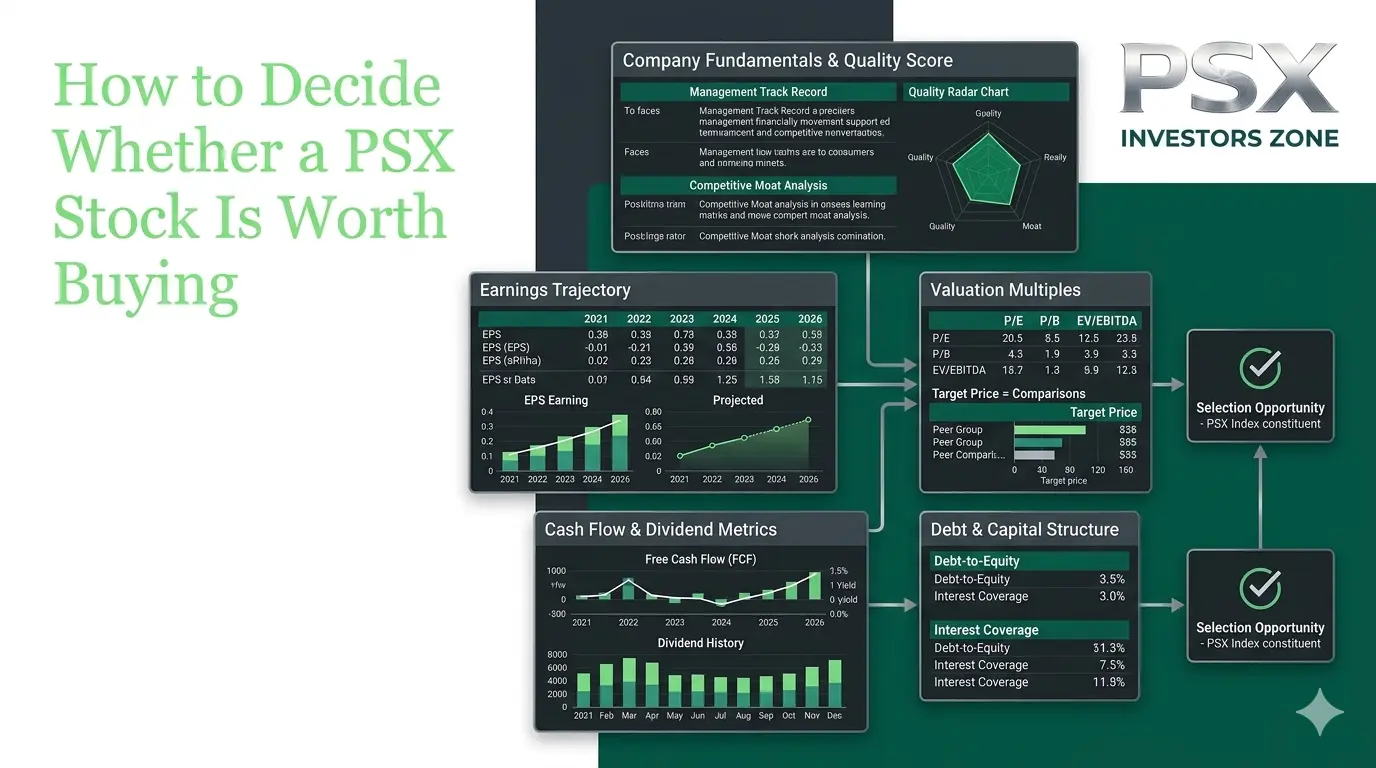
How to Decide Whether a PSX Stock Is Worth Buying
Introduction
Finding a stock worth buying is not simply about finding a company whose share price is rising.
A stock can belong to an excellent company and still be a poor investment if its market price is far above what the business fundamentals justify. On the other hand, a company that looks temporarily unpopular may offer an attractive opportunity if its fundamentals remain strong and its valuation is reasonable.
For PSX investors, the better question is:
Is this company worth owning at today's price?
Answering that question requires a structured approach.
Investors should examine:
- Business quality
- Revenue and earnings
- Cash flow
- Debt
- Financial ratios
- Competitive position
- Growth prospects
- Valuation
- Dividends
- Market conditions
- Key risks
- Shariah-compliance status
The goal is not to predict the next day's price.
The goal is to determine whether the business, valuation and investment thesis make sense for your objectives and risk tolerance.
Important: This article is for educational purposes only and does not recommend any specific PSX stock or guarantee investment returns.
Step 1: Understand What the Company Actually Does
Before looking at charts or ratios, understand the business.
Ask:
How does this company make money?
Then investigate:
- Main products or services
- Major customers
- Revenue sources
- Operating markets
- Main competitors
- Key suppliers
- Industry conditions
- Major risks
If you cannot explain how a company generates its revenue, you probably need more research before investing.
A Simple Test
Try to explain the company's business in two or three sentences.
If you cannot, continue researching.
Step 2: Check Revenue Growth
Revenue represents the company's sales.
Look at revenue over several years rather than focusing on one quarter.
For example:
| Year | Revenue |
|---|---|
| Year 1 | Rs. 50B |
| Year 2 | Rs. 57B |
| Year 3 | Rs. 65B |
| Year 4 | Rs. 72B |
| Year 5 | Rs. 81B |
Consistent growth can indicate increasing business activity.
But revenue growth alone is not enough.
A company can increase sales while profitability deteriorates.
Therefore, always connect:
Revenue → Profit → Cash Flow
Step 3: Examine Earnings
Net profit and EPS help investors understand whether the company is generating earnings for shareholders.
Look for:
- Consistent profitability
- EPS growth
- Stable or improving margins
- Earnings quality
- Sustainable profit sources
Be cautious when profits increase sharply because of unusual or non-recurring gains.
For example, a company might report higher profit because of:
- Asset sales
- One-time gains
- Accounting adjustments
- Currency effects
- Temporary tax benefits
These may not represent sustainable operating growth.
Step 4: Analyze EPS
EPS stands for Earnings Per Share.
A simplified formula is:
EPS = Net Profit ÷ Number of Shares Outstanding
Suppose a company earns Rs. 5 billion and has 1 billion shares.
Its EPS would be:
Rs. 5 per share
Now compare EPS across several years.
A company with:
Rs. 3 → Rs. 4 → Rs. 5 → Rs. 6
shows a different earnings trend from one with:
Rs. 8 → Rs. 7 → Rs. 5 → Rs. 4
However, EPS should always be considered alongside valuation and cash generation.
Step 5: Check Free Cash Flow
Profit is important, but cash generation matters too.
A commonly used simplified formula is:
Free Cash Flow = Operating Cash Flow − Capital Expenditure
A company generating consistent positive FCF may have greater flexibility to:
- Pay dividends
- Repay debt
- Reinvest in the business
- Strengthen its balance sheet
But negative FCF is not automatically bad.
A growing company may be investing heavily in new capacity.
The key question is:
Why is FCF negative, and what is the company getting in return for that investment?
Step 6: Analyze Debt
Debt can help a company expand, but excessive debt can increase financial risk.
Review:
- Debt-to-equity ratio
- Total debt
- Interest expense
- Interest coverage
- Short-term obligations
- Debt maturity profile
A company with manageable debt and strong cash generation may have greater financial flexibility.
A highly leveraged company with weak cash flow deserves more caution.
Step 7: Check Return on Equity
ROE measures how effectively a company generates profit from shareholders' equity.
A simplified formula is:
ROE = Net Profit ÷ Shareholders' Equity × 100
For example:
Net Profit = Rs. 10 billion
Shareholders' Equity = Rs. 50 billion
ROE:
10 ÷ 50 × 100 = 20%
A consistently healthy ROE can indicate efficient use of shareholder capital.
But be careful.
High debt can sometimes artificially increase ROE.
Therefore:
ROE + Debt Analysis
should be considered together.
Step 8: Examine Profit Margins
Margins show how much profit a company retains from its revenue.
Important measures include:
Gross Margin
Shows profitability after the direct cost of goods or services.
Operating Margin
Shows profitability from core operations.
Net Profit Margin
Shows how much net profit remains from revenue.
For example:
Revenue = Rs. 100 billion
Net Profit = Rs. 10 billion
Net Profit Margin = 10%
Look for stable or improving margins over time.
Step 9: Evaluate the Company's Competitive Advantage
Financial numbers tell you what happened.
Competitive advantage can help explain why the company may continue performing well.
Ask whether the company has:
- Strong brand recognition
- Cost advantages
- Distribution advantages
- High switching costs
- Strong market position
- Proprietary technology
- Economies of scale
- Long-term customer relationships
A company with a durable competitive advantage may be better positioned to protect profitability.
Step 10: Study the Industry
A great company in a declining industry can face significant challenges.
Research:
- Industry growth
- Competition
- Government regulations
- Commodity prices
- Consumer demand
- Import/export conditions
- Technology changes
- Interest-rate sensitivity
For PSX companies, sector-specific factors can be particularly important.
For example:
Banks: Interest rates, deposits, loan quality and spreads
Cement: Construction demand, energy costs, coal prices and capacity
Fertilizer: Agricultural demand, gas availability and pricing
Oil & Gas: Production, commodity prices and government policies
Technology: Export revenue, demand and foreign-currency exposure
Step 11: Calculate the P/E Ratio
The Price-to-Earnings ratio compares the stock price with earnings per share.
P/E = Share Price ÷ EPS
Suppose:
Share Price = Rs. 100
EPS = Rs. 10
P/E = 10x
But do not automatically assume:
Lower P/E = Better Stock
A low P/E may exist because investors expect:
- Earnings to decline
- Business risks to increase
- Sector growth to weaken
- Corporate problems to emerge
Likewise, a higher P/E may reflect stronger growth expectations.
Always ask:
What am I paying for the company's future earnings?
Step 12: Check the P/B Ratio
The Price-to-Book ratio compares market value with book value.
P/B = Market Price Per Share ÷ Book Value Per Share
It can be particularly useful when analyzing asset-heavy businesses and financial companies.
But P/B should be interpreted according to the company's business model.
Step 13: Look at Dividend Yield
For income-focused investors, dividends can be important.
A simplified formula is:
Dividend Yield = Annual Dividend Per Share ÷ Share Price × 100
For example:
Annual Dividend = Rs. 8
Share Price = Rs. 100
Dividend Yield = 8%
But a high dividend yield does not automatically mean a stock is attractive.
Ask:
- Is the dividend sustainable?
- Is FCF sufficient?
- Is profit stable?
- Is the payout ratio reasonable?
- Has the company consistently paid dividends?
Step 14: Check Dividend Sustainability
A company can pay a dividend today and reduce it later.
Compare:
Dividend + Earnings + Free Cash Flow
If dividends consistently exceed sustainable cash generation, investors should investigate how they are being financed.
A sustainable dividend is generally more valuable than a temporarily high dividend.
Step 15: Compare the Stock With Its Peers
Never analyze a company in isolation.
Compare it with similar PSX companies.
Create a simple comparison:
| Metric | Company A | Company B | Company C |
|---|---|---|---|
| P/E | — | — | — |
| P/B | — | — | — |
| ROE | — | — | — |
| Debt/Equity | — | — | — |
| Dividend Yield | — | — | — |
| EPS Growth | — | — | — |
This helps identify relative strengths and weaknesses.
However, numbers should be compared among genuinely comparable businesses.
Step 16: Determine Intrinsic Value
The most important question is not:
"Is this a good company?"
It is:
"Is the current market price reasonable relative to the company's value and future prospects?"
Intrinsic value can be estimated using different approaches, including:
- Discounted cash flow
- Earnings-based valuation
- Dividend-based valuation
- Asset-based valuation
- Comparable-company analysis
Each method has limitations.
The objective is not to find an exact number.
Instead, investors can develop a reasonable valuation range.
Step 17: Use a Margin of Safety
Even a careful valuation can be wrong.
Future earnings may disappoint.
Economic conditions may change.
Interest rates may move unexpectedly.
Competition may increase.
This is why investors often use a margin of safety.
For example, if your estimated intrinsic value is Rs. 150, you may not want to automatically buy at Rs. 149.
You could require a meaningful discount to your estimated value before considering the investment.
The larger the uncertainty, the more important valuation discipline becomes.
Step 18: Identify the Investment Catalyst
Ask:
What could make the company's value increase over the next few years?
Potential catalysts include:
- Earnings growth
- New capacity
- Higher margins
- Debt reduction
- New products
- Export expansion
- Regulatory changes
- Improved economic conditions
- Industry recovery
A stock can remain undervalued for a long time.
Understanding potential catalysts helps investors build a clearer thesis.
Step 19: Identify What Could Go Wrong
A good investment analysis should explain both the opportunity and the risks.
Ask:
What would make my investment thesis wrong?
Potential risks include:
- Earnings decline
- Higher debt
- Currency depreciation
- Political instability
- Regulatory changes
- Commodity-price increases
- Loss of market share
- Weak demand
- Management problems
- Higher interest rates
If you cannot identify the risks, you probably have not researched the company deeply enough.
Step 20: Check Management Quality
Management decisions can materially affect shareholder value.
Review:
- Capital allocation
- Dividend history
- Debt decisions
- Corporate governance
- Related-party transactions
- Expansion decisions
- Communication with shareholders
Look at the company's annual reports and official disclosures rather than relying only on social-media commentary.
The 5-Layer PSX Stock Evaluation Framework
A practical framework is:
Layer 1 — Business
Is this a good business?
Layer 2 — Financials
Is the business financially healthy?
Layer 3 — Growth
Can earnings and cash flow grow?
Layer 4 — Valuation
Is the stock reasonably priced?
Layer 5 — Risk
What could go wrong?
If a company passes all five layers, it deserves deeper consideration.
A Simple PSX Stock Scorecard
You can create a basic scorecard before making an investment decision.
| Category | Question | Score |
|---|---|---|
| Business | Is the business understandable? | /10 |
| Financials | Are earnings and cash flow healthy? | /10 |
| Debt | Is leverage manageable? | /10 |
| Growth | Are future prospects attractive? | /10 |
| Valuation | Is the price reasonable? | /10 |
| Dividends | Are dividends sustainable? | /10 |
| Management | Is capital allocation responsible? | /10 |
| Risk | Are major risks manageable? | /10 |
| Shariah | Does it meet your screening requirements? | /10 |
This is not a scientific prediction model.
It is a way to force yourself to think systematically rather than emotionally.
What Makes a Stock Worth Buying?
There is no universal formula.
But a potentially attractive long-term investment often combines:
Good Business
Healthy Financials
Sustainable Growth
Strong Cash Generation
Reasonable Valuation
Manageable Risk
The absence of one factor does not automatically make a stock unacceptable.
For example, a high-growth company may trade at a higher valuation.
A mature dividend company may have slower growth but stronger cash generation.
The correct analysis depends on the investment objective.
What About the Share Price?
A common mistake is thinking:
"This stock is only Rs. 50, so it is cheap."
Share price alone tells you very little.
A Rs. 50 stock can be more expensive than a Rs. 500 stock depending on:
- Number of shares
- Earnings
- Book value
- Cash flow
- Growth prospects
- Market capitalization
Always evaluate the stock relative to its fundamentals.
Don't Buy Because the Stock Is Trending
A stock can rise because of:
- Market momentum
- Speculation
- News
- Institutional buying
- Sector rotation
- Investor excitement
Momentum can continue—but it can also reverse quickly.
Before buying, ask:
Can I explain why this company's business deserves the current valuation?
If the only answer is:
"The price is going up,"
you need more research.
When Should You Avoid a PSX Stock?
Consider stepping back when:
- You do not understand the business
- Financial statements are unclear
- Debt is becoming excessive
- Cash flow consistently deteriorates
- Earnings are declining without a clear recovery path
- Valuation is extremely stretched
- The investment thesis depends entirely on speculation
- Major risks are difficult to quantify
- The company fails your Shariah requirements
Avoiding a bad investment can be just as important as finding a good one.
Shariah-Compliant Investors: Add an Extra Filter
For investors who follow Shariah-compliant investing principles, financial analysis should include an additional screening layer.
Check:
- Core business activity
- Shariah screening status
- Interest-based income
- Financial ratios
- Debt-related criteria
- Cash and other relevant screening measures
- Latest available Shariah-compliance information
Do not assume that a popular or profitable PSX company is automatically Shariah-compliant.
Likewise, Shariah compliance alone does not mean a stock is attractively valued.
The two questions are different:
Is the company Shariah-compliant?
and
Is the stock worth buying at its current price?
Both require separate analysis.
A 10-Minute Pre-Investment Checklist
Before buying a PSX stock, ask:
- What does the company do?
- How does it make money?
- Are revenue and earnings growing?
- Is EPS improving?
- Is operating cash flow healthy?
- Is free cash flow sustainable?
- Is debt manageable?
- Are ROE and margins healthy?
- Is the valuation reasonable?
- What are the biggest risks?
- What could drive future growth?
- Does the company meet my Shariah requirements?
If you cannot answer these questions, do more research before investing.
Key Takeaways
- A good stock is not necessarily a good investment at every price.
- Start by understanding the company's business model.
- Analyze revenue, earnings, EPS and profit margins.
- Check operating cash flow and Free Cash Flow.
- Examine debt and interest obligations.
- Use ROE and other ratios to assess financial efficiency.
- Compare the company's valuation with its own history and sector peers.
- Dividend yield should be evaluated together with dividend sustainability.
- Estimate intrinsic value rather than relying only on share price.
- Use a margin of safety because valuations are never perfectly certain.
- Identify both catalysts and risks.
- Compare the company with relevant competitors.
- Avoid buying solely because a stock is rising or popular.
- Shariah-conscious investors should independently verify current Shariah-compliance status.
- The final decision should be based on business quality + financial strength + growth + valuation + risk.
Frequently Asked Questions
How do I know if a PSX stock is worth buying?
Analyze the company's business quality, financial statements, earnings, cash flow, debt, growth prospects, valuation and risks. For Shariah-conscious investors, also verify current Shariah compliance.
What is the most important ratio when choosing a PSX stock?
There is no single best ratio. P/E, P/B, ROE, debt-to-equity, dividend yield, EPS growth and cash-flow measures answer different questions and should be considered together.
Is a low P/E stock automatically cheap?
No. A low P/E may reflect declining earnings, higher risk or weak future growth expectations. Always investigate why the valuation is low.
Is a high ROE always a good sign?
Not necessarily. High debt can increase ROE. Investors should analyze ROE alongside leverage and cash flow.
Should I buy a PSX stock because it pays a high dividend?
Not automatically. Check whether the dividend is supported by sustainable earnings and cash flow.
Should I use technical analysis or fundamental analysis?
They serve different purposes. Fundamental analysis helps evaluate the business and valuation, while technical analysis can help understand price trends and market behavior.
What is a good margin of safety?
There is no universal percentage. The appropriate margin depends on valuation uncertainty, business quality, growth assumptions and investment risk.
How often should I review a stock after buying it?
Long-term investors should periodically review financial results, business developments, valuation and the original investment thesis rather than reacting to every daily price movement.
Conclusion
Deciding whether a PSX stock is worth buying requires much more than checking its current share price.
A disciplined investor should move through a logical process:
Understand the Business → Analyze Financials → Check Cash Flow → Evaluate Debt → Study Growth → Assess Valuation → Identify Risks → Verify Shariah Compliance
The most important question is not:
"Will this stock go up tomorrow?"
Instead, ask:
"Am I buying a quality business at a price that gives me a reasonable risk-reward opportunity?"
That mindset can help investors avoid emotional decisions and focus on long-term fundamentals.
A strong company at an unreasonable price may be a poor investment.
A temporarily overlooked company with strong fundamentals and an attractive valuation may deserve deeper research.
Ultimately, successful investing is not about finding a perfect stock.
It is about developing a repeatable, disciplined process for evaluating businesses, prices and risks.