Price-to-Book (P/B) Ratio Explained: How to Value PSX Stocks
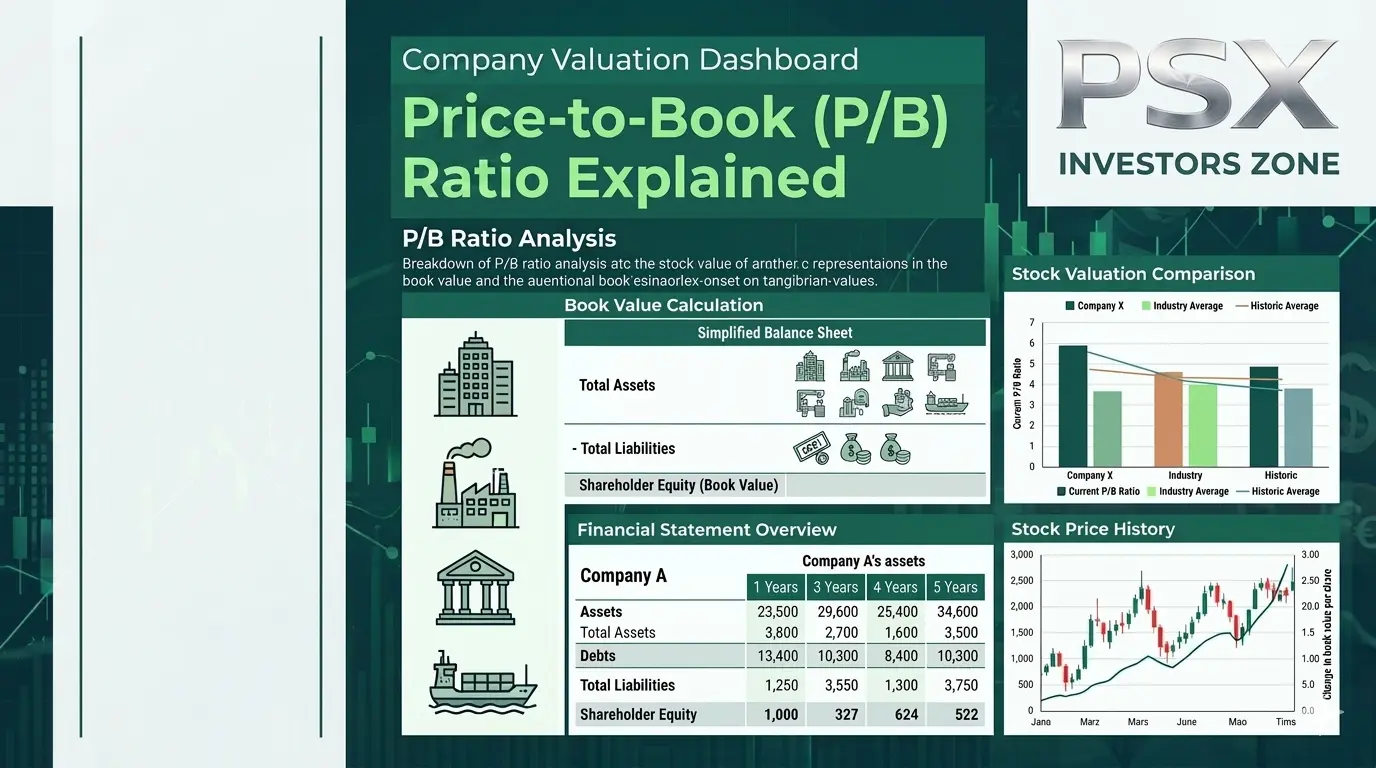
When investing in the Pakistan Stock Exchange (PSX), one of the most important questions is:
Is this stock fairly valued, undervalued, or overvalued?
While many investors focus on the Price-to-Earnings (P/E) Ratio, another powerful valuation metric is the Price-to-Book (P/B) Ratio.
The P/B Ratio compares a company's market price with its book value, helping investors understand how the market values the company's net assets.
At PSX Investors Zone, we encourage investors to use multiple financial ratios instead of relying on a single metric. The P/B Ratio is particularly useful when analyzing banks, insurance companies, investment companies, and other asset-intensive businesses.
What Is the Price-to-Book (P/B) Ratio?
The Price-to-Book (P/B) Ratio compares a company's current market price per share with its Book Value Per Share (BVPS).
In simple words:
The P/B Ratio shows how much investors are willing to pay for every rupee of a company's net assets.
It is one of the most widely used valuation ratios in fundamental analysis.
How Is the P/B Ratio Calculated?
Formula
P/B Ratio = Market Price Per Share ÷ Book Value Per Share (BVPS)
Example
Suppose:
- Market Price = Rs. 180
- Book Value Per Share = Rs. 120
P/B Ratio:
180 ÷ 120 = 1.5
This means investors are paying Rs. 1.50 for every Rs. 1.00 of the company's net assets.
What Is Book Value?
Book Value represents the company's net worth according to its balance sheet.
It is calculated as:
Book Value = Total Assets − Total Liabilities
Book Value Per Share (BVPS) is simply the company's book value divided by the total number of outstanding shares.
Why Is the P/B Ratio Important?
The P/B Ratio helps investors:
- Estimate whether a stock is fairly valued.
- Compare similar companies.
- Assess market expectations.
- Support long-term investment decisions.
- Identify potentially undervalued companies.
It is especially useful for companies with significant tangible assets.
What Does a Low P/B Ratio Mean?
A lower P/B Ratio may indicate:
- The stock is trading below its intrinsic asset value.
- Investors have low expectations for future performance.
- The company may be undervalued.
However, a low P/B Ratio does not automatically make a stock a good investment.
Sometimes the market is pricing in genuine business risks.
What Does a High P/B Ratio Mean?
A higher P/B Ratio may suggest:
- Strong investor confidence.
- High expected future growth.
- Valuable intangible assets.
- Premium market valuation.
Again, a high P/B Ratio is not necessarily bad—it depends on the company's fundamentals and industry.
Which Companies Is the P/B Ratio Best For?
The P/B Ratio is particularly useful for:
- Banks
- Insurance Companies
- Investment Companies
- Leasing Companies
- Cement Companies
- Manufacturing Businesses
- Asset-Heavy Industries
These businesses own substantial tangible assets that are reflected on their balance sheets.
P/B Ratio vs P/E Ratio
Although both are valuation tools, they measure different aspects of a company.
| Ratio | Measures |
|---|---|
| P/B Ratio | Market value compared with net assets |
| P/E Ratio | Market value compared with company earnings |
Many investors use both ratios together to gain a more complete understanding of valuation.
Example Comparison
| Company | Share Price | Book Value | P/B Ratio |
|---|---|---|---|
| Company A | Rs. 240 | Rs. 200 | 1.20 |
| Company B | Rs. 240 | Rs. 120 | 2.00 |
Although both companies have the same market price, Company A is trading closer to its book value.
Whether either stock is attractive depends on profitability, growth prospects, and overall financial health—not the P/B Ratio alone.
Limitations of the P/B Ratio
Like every financial ratio, the P/B Ratio has limitations.
It Ignores Profitability
A company may have a low P/B Ratio but still generate weak profits.
Review EPS and ROE alongside the P/B Ratio.
It Doesn't Reflect Future Growth
The P/B Ratio focuses on current book value, not future earnings potential.
It Is Less Useful for Asset-Light Businesses
Technology and service companies often derive much of their value from intangible assets that may not be fully reflected in book value.
One Ratio Is Never Enough
Always combine the P/B Ratio with:
- Earnings Per Share (EPS)
- Price-to-Earnings (P/E) Ratio
- Return on Equity (ROE)
- Return on Assets (ROA)
- Debt-to-Equity Ratio
- Cash Flow Analysis
- Financial Statements
Common Mistakes Investors Make
Buying Solely Because the P/B Ratio Is Low
A low P/B Ratio may indicate genuine financial problems rather than an undervalued opportunity.
Comparing Different Industries
Always compare companies operating within the same sector.
Ignoring Management Quality
Strong management can significantly influence a company's long-term value.
Ignoring Business Fundamentals
Revenue growth, profitability, debt, and cash flow remain essential when evaluating any investment.
How PSX Investors Zone Helps Investors
At PSX Investors Zone, we simplify investing by publishing practical educational content on:
- Company Valuation
- Financial Ratios
- Fundamental Analysis
- Financial Statements
- Company Research
- Dividend Investing
- Risk Management
- Long-Term Investing
- Shariah-Compliant Investing
Our mission is to help investors build knowledge and make informed investment decisions based on research rather than speculation.
Key Takeaways
- The P/B Ratio compares a company's market price with its book value.
- It helps investors evaluate whether a stock appears fairly valued.
- It is especially useful for banks, insurance companies, and other asset-heavy businesses.
- A low P/B Ratio does not always mean a stock is undervalued.
- Combine the P/B Ratio with EPS, ROE, ROA, and P/E Ratio before making investment decisions.
Frequently Asked Questions
What is a good P/B Ratio?
There is no single ideal P/B Ratio. A suitable value depends on the company's industry, business model, and growth prospects.
Is a lower P/B Ratio always better?
Not necessarily. A low P/B Ratio may indicate an undervalued company or reflect underlying financial or operational challenges.
What is Book Value?
Book Value is the difference between a company's total assets and total liabilities. It represents the net worth of the business according to its balance sheet.
Should I use the P/B Ratio alone?
No. Investors should combine the P/B Ratio with profitability ratios, cash flow analysis, and a review of the company's overall financial position.
Which industries benefit most from P/B analysis?
Banks, insurance companies, investment firms, and other businesses with significant tangible assets are commonly evaluated using the P/B Ratio.
Conclusion
The Price-to-Book (P/B) Ratio is an important valuation tool that helps investors compare a company's market price with its underlying net assets.
While it can provide valuable insights into whether a stock appears attractively valued, it should never be used in isolation. Combining the P/B Ratio with other financial metrics and a thorough review of the company's financial statements provides a more balanced and informed approach to investing.
By understanding the strengths and limitations of the P/B Ratio, investors can make more confident decisions when evaluating companies listed on the Pakistan Stock Exchange.
Educational Disclaimer: This article is for educational purposes only and does not constitute financial, investment, legal, tax, or Shariah advice. Investing in the Pakistan Stock Exchange involves risk, including the possible loss of capital. Always conduct your own research and consult qualified professionals before making investment decisions.