PSX Trading Fees, Taxes and Charges Explained
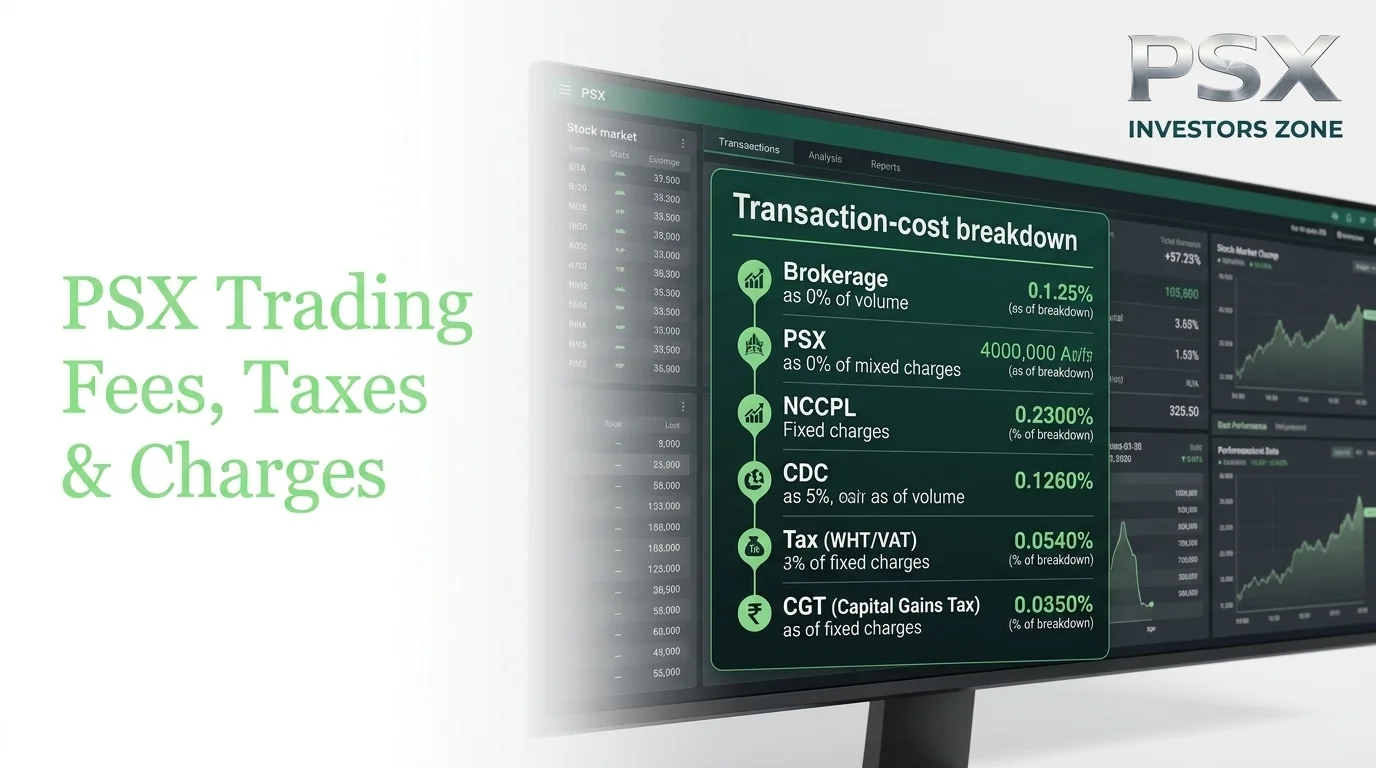
Understanding the cost of buying and selling shares is an important part of investing in the Pakistan Stock Exchange (PSX).
When you place a trade, the amount you pay or receive is not necessarily limited to the market value of the shares. Depending on the transaction, investors may encounter brokerage commission, exchange and clearing-related charges, CDC charges, taxes and other applicable statutory or regulatory levies.
Understanding these costs can help investors calculate the actual cost of a transaction and evaluate investment returns more accurately.
This guide explains the main PSX trading fees, taxes and charges, how they work, and what investors should check on their trade confirmation.
What Are PSX Trading Fees and Charges?
PSX trading costs are the various amounts that may apply when you buy or sell securities.
They can include:
- Brokerage commission
- PSX-related trading or transaction charges
- NCCPL-related clearing charges
- CDC-related charges
- SECP-related regulatory levies
- Government taxes and duties
- Capital Gains Tax (CGT), where applicable
- Other applicable transaction costs
The exact amount depends on the transaction, broker, security, applicable regulations and tax treatment.
PSX requires brokers to provide customers with a tariff schedule showing applicable commission, regulatory levies and statutory levies.
Main Types of Costs When Trading PSX Shares
A useful way to understand PSX transaction costs is to divide them into three broad categories:
1. Brokerage Charges
These are charges levied by your brokerage firm for executing trades.
2. Regulatory and Market Charges
These can include applicable charges associated with PSX, NCCPL, CDC and SECP.
3. Government Taxes and Levies
These can include applicable taxes and duties imposed under Pakistan's tax laws.
The exact charges applicable to an investor should be checked against the broker's current tariff schedule and the relevant tax rules.
1. Brokerage Commission
Brokerage commission is the fee charged by your broker for executing a trade.
The commission can depend on factors such as:
- Brokerage firm
- Transaction type
- Trade value
- Applicable brokerage agreement
- Market or product
- Regulatory limits and requirements
There is not one universal brokerage commission rate for every PSX broker.
PSX specifically advises investors to compare brokerage charges when selecting a broker.
Your broker's tariff schedule should therefore be checked before trading.
Example of Brokerage Commission
Suppose you purchase shares worth Rs. 100,000 and your broker charges a hypothetical commission of 0.15%.
The commission would be:
Rs. 100,000 × 0.15% = Rs. 150
This is only an example. Your actual brokerage rate may be different.
2. PSX Trading and Transaction Charges
Certain market-related charges can apply to transactions executed through PSX.
These charges are separate from the brokerage commission charged by your broker.
The applicable rates and structure can change, so investors should refer to the current PSX schedule and their broker's tariff disclosure rather than relying on an old percentage found online.
3. NCCPL Charges
The National Clearing Company of Pakistan Limited (NCCPL) performs important clearing and settlement functions in Pakistan's capital market.
Applicable NCCPL charges may form part of the costs associated with clearing transactions.
Your trade confirmation should disclose applicable regulatory levies and other charges.
PSX states that trade confirmations should include applicable regulatory levies involving the Exchange, CDC, NCCPL and SECP where applicable.
4. CDC Charges
The Central Depository Company of Pakistan Limited (CDC) provides securities depository infrastructure for the market.
Depending on the service and transaction, applicable CDC charges may arise.
These can relate to services associated with securities custody, settlement and other CDC functions.
Investors should check their broker's tariff schedule and the applicable CDC schedule for the current charges.
5. SECP-Related Levies
Certain regulatory charges or levies may apply to transactions.
PSX's investor guidance states that the broker's tariff schedule should disclose applicable regulatory levies, including those relating to PSX, CDC, NCCPL and SECP.
The applicable amount should be verified from the current tariff or trade confirmation.
6. Capital Gains Tax (CGT)
Capital Gains Tax is an important tax consideration when selling securities at a taxable gain.
CGT is generally associated with the capital gain arising from disposal of securities rather than simply buying shares.
The calculation and applicable rate depend on the relevant tax rules.
Current CGT Structure for PSX Investors
For Tax Year 2026, NCCPL's published CGT table shows different rates depending on when the securities were acquired and, for certain older securities, the holding period and ATL status. For securities acquired on or after July 1, 2024, the table shows a 15% rate for the applicable listed-securities category through the relevant period, while older acquisition dates can have different treatment.
For securities acquired on or after July 1, 2022 but on or before June 30, 2024, NCCPL's Tax Year 2026 table applies regressive rates based on holding period, with different rates for investors appearing and not appearing on the Active Taxpayer List (ATL).
For securities acquired on or after July 1, 2013 but on or before June 30, 2022, NCCPL lists a 12.5% rate for Tax Year 2026. Securities acquired before July 1, 2013 are listed at 0% in the NCCPL table.
Because tax rules can change through Finance Acts and other amendments, investors should verify the applicable rate for their transaction from the latest NCCPL and FBR information.
Why You Should Not Use One Fixed CGT Rate
A common mistake is to assume that every PSX investor pays the same CGT rate.
The applicable tax treatment can depend on:
- Acquisition date
- Holding period for certain categories of securities
- ATL status
- Type of security
- Current tax legislation
NCCPL publishes CGT information and issues annual capital-gains certificates to taxpayers.
7. Advance Taxes and Other Government Levies
Depending on the transaction and applicable tax legislation, other government taxes or levies may apply.
PSX's investor guidance identifies government taxes and duties as part of the statutory levies that can appear in the broker's tariff schedule.
Tax rates and rules can change through annual Finance Acts, so investors should not rely on outdated tax tables.
8. Dividend Tax Is Different From Trading Costs
A dividend received from a company is different from the cost of buying or selling shares.
When a listed company declares a cash dividend, applicable withholding tax can apply to the dividend according to the prevailing tax rules.
Therefore, investors should distinguish between:
Trading costs: Costs associated with buying or selling shares.
Dividend taxation: Tax that may apply to dividend income.
The applicable dividend tax treatment depends on the prevailing tax rules and the investor's circumstances.
How Much Does It Cost to Buy Shares in PSX?
There is no single fixed cost for every PSX transaction.
The total cost can depend on:
- Purchase value
- Brokerage commission
- Applicable PSX charges
- NCCPL charges
- CDC charges
- SECP-related levies
- Applicable taxes
- Other transaction-specific costs
Simple Example
Suppose an investor buys shares worth:
Rs. 100,000
Assume, purely for illustration, that the broker charges:
0.15% brokerage commission
Then:
Share purchase value = Rs. 100,000
Hypothetical brokerage commission = Rs. 150
Other applicable charges and taxes would then need to be added according to the actual transaction.
Therefore:
Total transaction cost ≠ Share purchase value alone
The exact amount should always be calculated from the broker's current tariff and the trade confirmation.
How Much Does It Cost to Sell Shares in PSX?
Selling shares can also involve transaction costs.
Depending on the transaction, these can include:
- Brokerage commission
- Applicable regulatory charges
- Applicable CDC/NCCPL charges
- Government taxes or levies
- Capital Gains Tax, where applicable
For this reason, an investor should calculate the net proceeds from a sale, rather than looking only at the selling price.
What Is the Difference Between Brokerage Commission and CGT?
These two costs are different.
Brokerage Commission
Paid to the broker for executing the trade.
Capital Gains Tax
A tax that may apply to a taxable capital gain when securities are disposed of.
For example, if an investor buys shares for Rs. 100,000 and later sells them for Rs. 120,000, the basic difference is:
Rs. 120,000 − Rs. 100,000 = Rs. 20,000
That does not automatically mean Rs. 20,000 is the final taxable amount in every situation. Applicable rules, adjustments and transaction costs must be considered when calculating the capital gain and tax.
What Is the Difference Between PSX, NCCPL and CDC Charges?
These organizations have different roles in the market infrastructure.
PSX
Pakistan Stock Exchange operates the exchange where listed securities are traded.
NCCPL
NCCPL performs clearing and settlement-related functions.
CDC
CDC provides securities depository and related services.
A trade can therefore involve charges associated with different parts of the market infrastructure.
PSX's investor guidance explicitly identifies PSX, CDC, NCCPL and SECP-related regulatory levies among the charges that may appear in the broker's tariff schedule.
Where Can You See Your PSX Trading Charges?
Your broker should provide a trade confirmation or contract note after an executed transaction.
PSX requires brokers to provide customers with trade confirmations containing information such as:
- Execution date
- Security name and quantity
- Trade nature
- Price
- Commission rate
- Other charges
- Applicable regulatory levies
- Applicable statutory taxes and duties
PSX says the broker should provide the contract note within 24 hours of trade execution through the agreed communication method.
This makes the trade confirmation one of the most useful documents for checking your actual transaction cost.
How to Calculate the Total Cost of a PSX Trade
A simplified calculation is:
Total Buy Cost = Share Purchase Value + Brokerage Commission + Applicable Charges + Applicable Taxes
For a sale:
Net Sale Proceeds = Sale Value − Brokerage Commission − Applicable Charges − Applicable Taxes
These are simplified formulas for understanding the structure. The actual calculation can depend on the transaction and prevailing regulations.
Example: Buying Shares
Suppose:
- Share price = Rs. 200
- Quantity = 500 shares
The basic purchase value is:
Rs. 200 × 500 = Rs. 100,000
Now add the applicable:
- Brokerage commission
- Regulatory charges
- CDC/NCCPL charges where applicable
- Taxes and other statutory levies
The final amount payable will therefore be higher than the basic Rs. 100,000 share value.
Example: Selling Shares at a Profit
Suppose:
- Purchase value = Rs. 100,000
- Sale value = Rs. 130,000
Basic price difference:
Rs. 130,000 − Rs. 100,000 = Rs. 30,000
The investor should not automatically treat Rs. 30,000 as the final after-tax profit.
The calculation may need to account for:
- Purchase-side costs
- Sale-side costs
- Applicable CGT
- Relevant tax rules
This is why understanding transaction costs is important when calculating investment returns.
How Trading Costs Affect Your Investment Returns
Trading costs reduce the amount you ultimately retain from an investment.
For example, if an investment generates a small price gain but the investor frequently buys and sells, repeated transaction costs can reduce the overall result.
This is particularly relevant for frequent trading.
Investors should therefore consider the total cost of each transaction rather than focusing only on the share price.
How to Reduce Unnecessary Trading Costs
Investors can improve cost awareness by:
Compare Broker Tariffs
Compare the applicable brokerage charges and services before opening an account.
Understand the Full Cost
Look beyond the advertised commission and check other applicable charges and taxes.
Review Every Trade Confirmation
Check whether the charges shown match your broker's agreed tariff.
Avoid Unnecessary Trading
Frequent buying and selling can create additional transaction costs.
Keep Records
Maintain trade confirmations, account statements and tax documents for proper record keeping.
PSX Trading Fees Checklist
Before placing a trade, check:
- Brokerage commission
- Broker's current tariff schedule
- PSX-related charges
- NCCPL-related charges
- CDC-related charges
- SECP-related levies
- Applicable government taxes
- Capital Gains Tax treatment
- ATL status where relevant
- Trade confirmation
- Total purchase or sale cost
- Tax documentation
Important: Tax Rates Can Change
Taxes and regulatory charges are not permanently fixed.
Pakistan's tax rules can change through Finance Acts, amendments, notifications and regulatory updates.
For example, FBR currently publishes separate withholding-tax rate cards for different tax years, and the current rate-card page identifies the Tax Year 2027 card as updated through Finance Act 2026.
Therefore, investors should verify current tax rates before making tax-related calculations.
For capital gains on listed securities, NCCPL publishes the applicable CGT information and annual CGT certificates.
Frequently Asked Questions
What are the main charges when trading shares in PSX?
The main categories can include brokerage commission, PSX-related charges, NCCPL charges, CDC charges, SECP-related levies and applicable government taxes. Capital Gains Tax may also apply when securities are sold at a taxable gain.
Is brokerage commission the same for every PSX broker?
No. Brokerage charges can vary between brokerage firms. PSX advises investors to consider brokerage charges when selecting a broker.
Do I pay tax when I buy shares in PSX?
The applicable taxes and levies depend on the transaction and prevailing tax rules. Buying shares and selling shares can have different tax implications, so investors should check the current applicable rules.
Do I pay Capital Gains Tax when I sell PSX shares?
Capital Gains Tax can apply to taxable gains from the disposal of listed securities. The applicable treatment depends on factors such as acquisition date, holding period for certain categories, ATL status and prevailing tax law.
What is CGT in PSX?
CGT stands for Capital Gains Tax. It is a tax on applicable capital gains arising from the disposal of securities.
Where can I find my actual PSX trading charges?
Your broker's tariff schedule and trade confirmation are key sources. PSX requires brokers to disclose applicable commission, regulatory levies and statutory taxes and duties.
Does PSX have a fixed brokerage commission?
No. Brokerage commission can vary between brokerage firms and according to the applicable terms and regulations.
What is NCCPL's role in PSX?
NCCPL performs clearing and settlement functions within Pakistan's capital-market infrastructure.
What is CDC's role in PSX?
CDC provides securities depository and related services, including electronic custody and movement of securities.
Can PSX trading charges change?
Yes. Brokerage tariffs, regulatory charges and tax rules can change. Investors should check the latest applicable schedules before calculating transaction costs.
Final Takeaway
Understanding PSX trading fees, taxes and charges is essential for calculating the real cost of buying and selling shares.
The total cost can include:
Brokerage Commission + PSX Charges + NCCPL/CDC Charges + Regulatory Levies + Applicable Taxes
The exact amount depends on the transaction, broker, security and prevailing rules.
Before trading, review your broker's current tariff schedule. After trading, check your contract note or trade confirmation to make sure the commission, charges and taxes have been correctly disclosed.
For tax calculations, always use the latest information published by the relevant authorities because tax rates and rules can change.
PSX Investors Zone provides educational content on the Pakistan Stock Exchange, investing, financial analysis and Shariah-compliant investing to help investors understand the market and make informed decisions.
Educational Disclaimer: This article is for educational and informational purposes only. It is not financial, investment, tax or trading advice and does not guarantee profits or returns. Tax rules, rates and market charges can change. Investors should verify the applicable rules with their broker and the relevant official authorities before making financial or tax decisions.