Best Shariah-Compliant Stocks in Pakistan for Long-Term Investment: How to Research and Evaluate PSX Companies
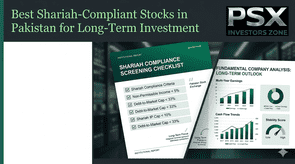
Introduction
Finding the best Shariah-compliant stocks in Pakistan is not simply about looking for companies whose share prices are rising.
A stronger approach is to identify businesses that combine:
- Shariah compliance
- Strong business fundamentals
- Sustainable earnings
- Healthy cash flow
- Sound financial statements
- Reasonable valuation
- Competitive advantages
- Responsible management
- Long-term growth potential
For investors following Islamic investment principles, Shariah screening is an important first step—but it should not be the only step.
A company can meet Shariah screening requirements and still be an unattractive investment because its valuation is too high, earnings are declining, debt is increasing, or its business fundamentals are weakening.
This guide explains how investors can research and evaluate Shariah-compliant PSX companies for long-term investment.
Important: This article is an educational framework, not a recommendation to buy or sell any particular stock. Shariah status and financial conditions can change, so investors should verify the latest information before making an investment decision.
What Are Shariah-Compliant Stocks?
Shariah-compliant stocks are shares of companies that meet the applicable Shariah screening requirements.
The screening generally considers two broad areas:
- The company's business activities
- Specified financial and other screening criteria
PSX provides Shariah-compliant market benchmarks including the PSX-KMI All Share Index and KMI-30 Index.
PSX states that the KMI-30 tracks 30 of the most liquid Shariah-compliant companies, while the PSX-KMI All Share Index comprises Shariah-compliant companies listed on PSX. :contentReference[oaicite:0]{index=0}
However, index inclusion should not automatically be interpreted as an investment recommendation.
Why Shariah Screening Matters
Investors who follow Islamic investment principles generally want their investments to avoid businesses and financial structures that do not meet applicable Shariah requirements.
The KMI methodology considers factors including the nature of the company's business and specified financial ratios.
PSX's published KMI methodology explains that a company's core business must not violate Shariah principles and provides financial screening criteria for eligible securities. :contentReference[oaicite:1]{index=1}
This means investors should not simply look at whether a company is listed on PSX.
They should also verify its current Shariah status.
Is Every Shariah-Compliant Stock a Good Long-Term Investment?
No.
This is one of the most important distinctions for beginners.
Shariah compliance ≠ investment quality.
A stock can be Shariah-compliant while still having:
- Weak earnings
- Poor cash flow
- Excessive valuation
- Declining sales
- Weak management
- High business risk
- Poor competitive positioning
Therefore, investors should use a two-stage process:
Stage 1: Shariah Screening
Determine whether the company meets the applicable Shariah requirements.
Stage 2: Investment Analysis
Determine whether the company is financially and fundamentally attractive at its current valuation.
This distinction can help prevent investors from confusing compliance with investment performance.
How to Find Shariah-Compliant PSX Companies
One practical starting point is the official PSX Shariah-compliant investment resources and index information.
PSX maintains information on the PSX-KMI All Share Index, KMI-30, and other Islamic investment products. :contentReference[oaicite:2]{index=2}
PSX also provides a stock screener that allows investors to examine listed securities using criteria such as sector, index membership, market capitalization, price, P/E ratio, dividend yield, free float, and trading volume. :contentReference[oaicite:3]{index=3}
For research purposes, investors can use these tools to build an initial universe of companies and then conduct deeper fundamental analysis.
KMI-30 vs PSX-KMI All Share Index
Understanding the difference is useful.
PSX-KMI All Share Index
This index comprises Shariah-compliant companies listed on PSX according to the applicable methodology.
It can therefore provide a broader universe for investors researching Shariah-compliant companies.
KMI-30
The KMI-30 tracks 30 of the most liquid Shariah-compliant companies listed on PSX and uses float-adjusted market capitalization with a 12% cap on individual company weights. :contentReference[oaicite:4]{index=4}
The KMI-30 can therefore be useful when researching larger and more liquid Shariah-compliant companies.
But neither index should be treated as a guaranteed list of the "best stocks."
Important: Shariah Status Can Change
Investors should never assume that a company's Shariah status will remain unchanged forever.
PSX periodically recomposes its Shariah-related indexes.
In May 2026, for example, PSX announced changes to the KMI-30 composition based on Shariah status and the applicable index methodology. :contentReference[oaicite:5]{index=5}
PSX also announced in February 2026 that the KMI Shariah screening methodology was being revised, including a change to the interest-bearing debt-to-total-assets threshold from 37% to 33%, along with a new Shariah compliance rating mechanism. :contentReference[oaicite:6]{index=6}
This is why investors should always verify the latest screening status and methodology instead of relying on an old article, social-media post, or outdated stock list.
The 10-Step Process for Finding Quality Shariah-Compliant Stocks
Step 1: Start With Shariah Screening
Begin by confirming that the company meets the applicable Shariah screening criteria.
Check:
- Business activity
- Financial screening
- Current Shariah status
- Relevant screening methodology
- Latest screening date
Do not rely on an old list.
Step 2: Understand the Company's Business
Before analyzing ratios, understand what the company actually does.
Ask:
What does the company sell?
Who are its customers?
How does it make money?
What drives demand?
What could cause its profits to decline?
A business that is easy to understand is often easier to analyze.
Step 3: Examine Revenue Growth
Revenue represents the income generated from a company's core business activities.
Look at:
- Revenue growth over several years
- Revenue consistency
- Segment performance
- Geographic exposure
- Customer concentration
Do not judge a company based on one year's growth.
Look for a sustainable pattern.
Step 4: Analyze EPS Growth
EPS = Earnings Per Share
EPS helps investors understand how much profit is attributable to each share.
When evaluating a long-term company, examine:
- Historical EPS
- EPS growth
- Earnings volatility
- Future earnings expectations
Consistent earnings growth can be a positive sign, but investors should also investigate why earnings are growing.
Step 5: Check Profit Margins
Profit margins show how much profit a company generates relative to its revenue.
Useful measures include:
- Gross profit margin
- Operating margin
- Net profit margin
A company with stable or improving margins may have stronger pricing power or cost control.
However, margins should be compared with companies operating in the same industry.
Step 6: Analyze ROE
Return on Equity (ROE) measures how effectively a company generates profit relative to shareholders' equity.
A simplified formula is:
ROE = Net Income ÷ Shareholders' Equity × 100
A consistently strong ROE can indicate efficient use of shareholder capital.
But a high ROE is not automatically positive.
Excessive leverage can sometimes artificially increase ROE.
Therefore, analyze ROE alongside the balance sheet.
Step 7: Analyze Debt and Financial Strength
Debt is an important consideration when researching long-term investments.
Look at:
- Debt-to-equity
- Total liabilities
- Cash balances
- Interest-related expenses
- Debt maturity
- Free cash flow
For Shariah-conscious investors, the relevant Shariah screening methodology also includes financial criteria.
Do not confuse a company's general financial leverage analysis with its Shariah screening status. They serve different purposes.
Step 8: Study Cash Flow
Profit does not always equal cash.
Review:
- Operating cash flow
- Investing cash flow
- Financing cash flow
- Free cash flow
A company may report accounting profits while experiencing weak cash generation.
For long-term investors, sustainable cash generation can be an important indicator of business quality.
Step 9: Evaluate the Valuation
A great company can become a poor investment if you pay too much for it.
Useful valuation measures include:
P/E Ratio
Compares market price with earnings.
P/B Ratio
Compares market value with book value.
Dividend Yield
Measures annual dividend relative to share price.
Intrinsic Value
Attempts to estimate the underlying value of a business using appropriate valuation methods.
Margin of Safety
Represents the difference between estimated value and market price.
The goal is not to find the stock with the lowest P/E.
The goal is to understand whether the current price is reasonable relative to the company's quality, growth prospects, and risks.
Step 10: Study Dividends
For long-term investors, dividends can be an important component of total returns.
But a high dividend yield does not automatically make a company attractive.
Examine:
- Dividend history
- Earnings
- Free cash flow
- Payout ratio
- Balance-sheet strength
- Future capital requirements
A sustainable dividend is generally more meaningful than a temporarily high dividend.
Financial Ratios to Use When Researching PSX Stocks
A strong fundamental analysis can include several ratios.
| Ratio | What It Helps Analyze |
|---|---|
| P/E | Valuation relative to earnings |
| P/B | Market value relative to book value |
| EPS | Earnings attributable per share |
| ROE | Return generated on equity |
| ROA | Profitability relative to assets |
| Debt-to-Equity | Financial leverage |
| Current Ratio | Short-term liquidity |
| Quick Ratio | More conservative liquidity |
| Interest Coverage | Ability to cover interest expense |
| Dividend Yield | Dividend relative to share price |
| Dividend Payout | Portion of earnings distributed as dividends |
No single ratio should determine an investment decision.
How to Compare Two Shariah-Compliant Companies
Suppose two companies operate in the same sector.
Company A has:
- Higher revenue growth
- Stronger ROE
- Better cash flow
- Lower valuation
- Sustainable dividends
Company B has:
- Slower earnings growth
- Higher valuation
- Weaker cash generation
- Higher financial risk
Both may meet Shariah screening requirements.
That does not mean they are equally attractive investments.
The investor still needs to compare:
Quality + Growth + Financial Strength + Valuation + Risk
Look for Competitive Advantages
A strong long-term company may have an economic advantage that protects its business.
Possible competitive advantages include:
- Strong brand
- Cost leadership
- Distribution network
- High switching costs
- Scale
- Technology
- Valuable licenses
- Strong customer relationships
Ask:
What prevents competitors from taking this company's market share?
If there is no clear answer, investigate further.
Analyze Management Quality
Financial numbers are important, but management matters too.
Look at:
- Capital allocation
- Corporate governance
- Transparency
- Strategic decisions
- Dividend policy
- Debt management
- Treatment of minority shareholders
A good business can be damaged by poor capital allocation.
Read the Annual Report
The annual report can provide valuable information that stock-screening websites cannot fully capture.
Look for:
- Business overview
- Chairman's report
- Directors' report
- Financial statements
- Notes to accounts
- Segment information
- Risks
- Related-party transactions
- Auditor's report
- Future strategy
Do not analyze a company solely from a stock-price chart.
Use the PSX Stock Screener
PSX's official stock screener provides useful market data including:
- Market capitalization
- Price
- One-year change
- P/E ratio
- Dividend yield
- Free float
- Average 30-day volume
- Index membership
This can help investors narrow a large universe of listed companies into a smaller research list. :contentReference[oaicite:7]{index=7}
But a screener is only a starting point.
It does not replace reading financial statements and understanding the business.
What Makes a Strong Long-Term Shariah-Compliant Investment?
A potentially attractive long-term candidate may combine several characteristics:
1. Shariah Compliance
The company meets the applicable current screening requirements.
2. Strong Business
The company has a clear and sustainable business model.
3. Growing Earnings
Profitability is stable or improving over time.
4. Healthy Cash Flow
The business generates cash from operations.
5. Strong Balance Sheet
Financial obligations are manageable.
6. Competitive Advantage
The business has some protection from competition.
7. Quality Management
Management allocates capital responsibly.
8. Reasonable Valuation
The market price does not excessively discount unrealistic expectations.
9. Sustainable Dividends
Where dividends are paid, they are supported by earnings and cash generation.
10. Manageable Risk
The investment's downside risks are understood.
Red Flags to Watch
Even if a stock passes an initial Shariah screen, investors should investigate warning signs.
Declining Revenue
Persistent sales declines can indicate weakening demand.
Falling Margins
Could indicate rising costs or pricing pressure.
Weak Cash Flow
Profit without cash generation deserves closer examination.
Rising Debt
Increasing financial obligations can create additional risk.
Excessive Valuation
A high-quality business can still be overpriced.
Frequent Equity Dilution
Issuing additional shares can reduce existing shareholders' ownership percentage.
Poor Governance
Weak transparency or questionable capital-allocation decisions should be taken seriously.
Unsustainable Dividends
A dividend that is not supported by earnings or cash flow may not be sustainable.
Should You Buy the "Best" Shariah-Compliant Stock?
There may not be one universally "best" stock.
The appropriate investment depends on:
- Valuation
- Risk tolerance
- Investment horizon
- Portfolio diversification
- Financial goals
- Business quality
- Shariah status
A company that looks attractive at one valuation may become unattractive after a large price increase.
Therefore, focus on finding high-quality businesses at sensible valuations, rather than searching for one stock that will outperform everything else.
Build a Shariah-Compliant Watchlist
Instead of immediately buying a stock, create a watchlist.
For each company record:
| Category | What to Track |
|---|---|
| Shariah | Current screening status |
| Business | Business model |
| Revenue | 3–5 year trend |
| EPS | Growth and consistency |
| ROE | Profitability |
| Debt | Financial strength |
| Cash Flow | Operating and free cash flow |
| Dividend | History and sustainability |
| P/E | Relative valuation |
| P/B | Relative valuation |
| Risks | Major downside factors |
| Fair Value | Your valuation estimate |
Review the watchlist periodically.
This encourages disciplined investing instead of emotional buying.
How Often Should You Check Shariah Status?
Do not assume that a company's Shariah status remains unchanged indefinitely.
PSX's Shariah indexes are periodically reviewed and recomposed.
PSX has also revised its Shariah screening methodology in 2026, with further implementation scheduled for the November 2026 recomposition based on June 2026 financial information. :contentReference[oaicite:8]{index=8}
Therefore:
Always verify current status before making an investment decision.
A Simple Stock Research Formula
For beginners, use this framework:
Shariah Compliance
↓
Business Quality
↓
Financial Strength
↓
Earnings & Cash Flow
↓
Competitive Advantage
↓
Management Quality
↓
Valuation
↓
Risk
↓
Investment Decision
This process is much stronger than simply asking:
"Which PSX stock should I buy?"
Common Mistakes in Shariah-Compliant Stock Investing
Mistake 1: Treating Shariah Compliance as a Buy Signal
Compliance does not guarantee investment quality.
Mistake 2: Using Outdated Shariah Lists
Screening methodologies and company statuses can change.
Mistake 3: Buying Based on Dividend Yield Alone
A high yield may be caused by a falling share price or an unsustainable dividend.
Mistake 4: Ignoring Valuation
A strong company can still be overpriced.
Mistake 5: Looking Only at One Ratio
Financial analysis requires multiple measures.
Mistake 6: Ignoring Cash Flow
Accounting profit and cash generation are not the same.
Mistake 7: Chasing Past Performance
Historical returns do not guarantee future results.
Mistake 8: Following Social-Media Tips
Research should come before investment decisions.
Key Takeaways
- Shariah compliance is an important starting point for Islamic investors, not the entire investment analysis.
- PSX provides Shariah-focused benchmarks including the PSX-KMI All Share Index and KMI-30.
- Shariah status and screening methodologies can change, so verify current information.
- Understand the company's business before analyzing its stock.
- Examine revenue, EPS, margins, ROE, debt, cash flow, and dividends.
- Use valuation measures such as P/E, P/B, and intrinsic value.
- Compare companies with their industry peers and historical performance.
- Read annual reports instead of relying only on price charts or social-media opinions.
- Build a watchlist and monitor companies systematically.
- A "best stock" is not universal; valuation, quality, risk, and investment objectives all matter.
- Long-term investing requires patience, research, diversification, and disciplined risk management.
Frequently Asked Questions
What are the best Shariah-compliant stocks in Pakistan?
There is no single universally best Shariah-compliant stock. Investors should identify companies that meet current Shariah screening requirements and then evaluate their business quality, financial strength, growth, valuation, dividends, and risks.
How can I find Shariah-compliant stocks on PSX?
The PSX-KMI All Share Index and KMI-30 are useful starting points. PSX also provides official Shariah-compliant investment resources and market data. Always verify the latest screening status before investing. :contentReference[oaicite:9]{index=9}
Is KMI-30 a list of the best Shariah-compliant stocks?
Not exactly. KMI-30 tracks 30 of the most liquid Shariah-compliant companies according to its methodology. Index inclusion does not mean every constituent is automatically the best investment for every investor. :contentReference[oaicite:10]{index=10}
Can a Shariah-compliant stock become non-compliant?
Yes. A company's business activities or financial characteristics can change, and Shariah screening methodologies can also be revised. Investors should check current information.
What financial ratios should I use?
Useful ratios include P/E, P/B, EPS, ROE, ROA, debt-to-equity, current ratio, quick ratio, dividend yield, and dividend payout ratio.
Is a high dividend yield a good reason to buy a stock?
Not by itself. Investors should examine whether the dividend is supported by sustainable earnings and cash flow and whether the share price is reasonable.
Should beginners invest for the long term?
Long-term investing can reduce the emphasis on short-term price movements, but it does not eliminate investment risk. Beginners should understand the business, valuation, and risks before investing.
Does Shariah compliance guarantee returns?
No. Shariah compliance does not guarantee profits, dividends, capital appreciation, or protection from losses.
Conclusion
Finding the best Shariah-compliant stocks in Pakistan requires more than identifying a company on a Shariah-compliant list.
A disciplined investor should follow a complete process:
Verify Shariah compliance → Understand the business → Analyze financial statements → Evaluate earnings and cash flow → Assess management → Calculate valuation → Identify risks → Make a disciplined decision.
The objective is not to predict which stock will rise the most next month.
For long-term investors, the more important objective is to identify quality businesses that meet the applicable Shariah requirements and are available at valuations that make sense relative to their fundamentals and risks.
At PSX Investors Zone, our focus is on investor education, research, disciplined investing, and Shariah-compliant investment guidance—not guaranteed returns or profit promises.
Educational Disclaimer: This article is for educational purposes only and does not constitute financial, investment, legal, tax, or Shariah advice. Shariah screening status, methodologies, financial results, valuations, and market conditions can change. Always verify the latest official information and conduct your own research before making investment decisions. Investing in PSX involves risk, including possible loss of capital.