How Economic Conditions Affect PSX
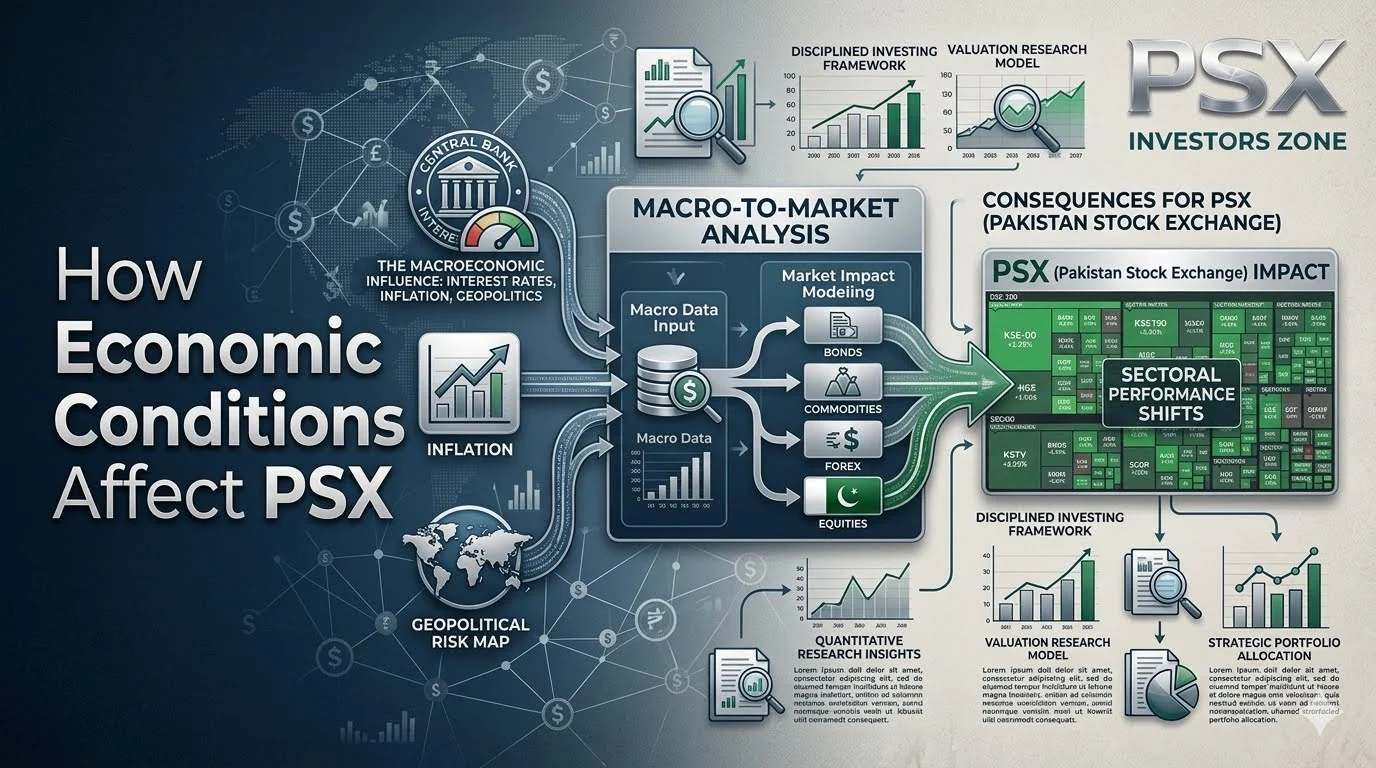
Introduction
The Pakistan Stock Exchange does not operate in isolation.
Corporate earnings, investor sentiment and stock valuations are influenced by the broader economic environment. Changes in interest rates, inflation, economic growth, exchange rates, government policies and foreign investment can all affect listed companies and the overall PSX.
For investors, understanding these relationships can make market movements easier to interpret.
However, economic news does not affect every company in the same way.
A weaker Pakistani rupee may create challenges for an import-dependent company while benefiting an exporter. Higher interest rates can pressure highly leveraged businesses but may create a different environment for banks.
This is why investors should think beyond:
"Is the economy good or bad?"
Instead, ask:
"How is this economic change likely to affect the companies I own or am considering?"
Important: This article is for educational purposes only and does not predict PSX performance or recommend any specific stock.
What Is the Relationship Between the Economy and PSX?
The stock market represents ownership in businesses.
When economic conditions improve, companies may experience:
- Higher demand
- Greater sales
- Better capacity utilization
- Improving profitability
- Stronger cash flows
This can support investor confidence and valuations.
When economic conditions deteriorate, companies may face:
- Lower demand
- Higher costs
- Reduced margins
- Expensive financing
- Currency pressures
- Lower earnings expectations
These factors can affect stock prices.
The relationship is not always immediate, however.
Markets often react to expectations about future economic conditions, not just current data.
1. Interest Rates
Interest rates are among the most important economic variables for PSX investors.
When the State Bank of Pakistan changes its policy rate, it can influence:
- Corporate borrowing costs
- Consumer financing
- Bank profitability
- Investment decisions
- Stock valuations
- Investor preferences
Higher Interest Rates
Higher rates can increase borrowing costs for companies.
Businesses with substantial debt may experience:
- Higher interest expenses
- Lower net profit
- Reduced investment
- Lower cash flow
Higher rates can also make fixed-income investments relatively more attractive compared with equities.
Lower Interest Rates
Lower rates can reduce financing costs.
They may support:
- Business expansion
- Consumer borrowing
- Corporate investment
- Equity valuations
But the impact depends on the company's sector and financial structure.
2. Inflation
Inflation measures the general increase in prices over time.
For companies, inflation can affect:
- Raw-material costs
- Salaries
- Transportation
- Energy expenses
- Consumer purchasing power
The effect on profitability depends partly on pricing power.
Company With Strong Pricing Power
It may be able to increase prices and protect margins.
Company With Weak Pricing Power
It may struggle to pass higher costs to customers.
Therefore, when inflation rises, investors should examine:
Revenue Growth + Cost Growth + Pricing Power + Margins
rather than assuming every company will be affected equally.
3. GDP and Economic Growth
GDP growth provides a broad measure of economic activity.
When economic growth improves, businesses may benefit from:
- Increased consumer spending
- Higher industrial activity
- Greater investment
- Stronger demand
- Improved corporate earnings
When growth slows, cyclical companies may experience weaker demand.
However, defensive businesses may be less sensitive to economic cycles.
4. Pakistani Rupee and Exchange Rates
Currency movements can have a major impact on PSX companies.
A weaker rupee can increase the local-currency cost of imported:
- Machinery
- Raw materials
- Fuel
- Chemicals
- Components
This can pressure companies that rely heavily on imports.
But exporters may benefit because foreign-currency revenue can translate into more Pakistani rupees.
Investors Should Ask
For each company:
- Does it import?
- Does it export?
- Does it have foreign-currency debt?
- Does it have foreign-currency revenue?
- Can it pass higher costs to customers?
The same currency movement can therefore help one company while hurting another.
5. Foreign Investment
Foreign investors can influence PSX liquidity and sentiment.
Foreign portfolio flows may respond to:
- Interest-rate expectations
- Economic reforms
- Currency stability
- Political developments
- Valuations
- Global risk appetite
Persistent foreign buying can support demand for selected equities.
Persistent selling can create additional pressure.
However:
Foreign buying does not guarantee that PSX will rise.
Investors should examine the underlying reasons behind the flows and which sectors or companies are receiving the investment.
6. Government Policies
Government decisions can directly affect listed companies.
Relevant policies may involve:
- Taxes
- Energy prices
- Import duties
- Export incentives
- Subsidies
- Regulation
- Infrastructure spending
- Privatization
- Industrial policy
A change in taxation, for example, can materially affect corporate profitability.
Investors should therefore monitor major policy announcements and assess their company-specific impact.
7. Fiscal Deficit and Government Borrowing
Government borrowing can influence the broader financial environment.
Large financing requirements may affect:
- Interest rates
- Liquidity
- Private-sector credit
- Investor preferences
When banks have strong demand for government securities, the availability and pricing of credit for private businesses can also be affected.
This can matter for companies that depend heavily on borrowing to finance operations or expansion.
8. Current Account and External Financing
Pakistan's external position can influence investor confidence.
Investors may monitor:
- Current account balance
- Exports
- Imports
- Remittances
- Foreign exchange reserves
- External debt
- External financing requirements
Improving external stability can reduce pressure on the currency and support broader confidence.
External imbalances can increase concerns about currency and financing risks.
9. Energy Prices
Energy costs are particularly important for many Pakistani industries.
Changes in:
- Electricity prices
- Gas prices
- Oil prices
- Coal prices
can materially affect corporate expenses.
Energy-intensive sectors such as manufacturing, cement and chemicals may be particularly sensitive.
Investors should therefore understand the company's energy exposure before assuming that higher or lower energy prices will benefit the stock.
10. Commodity Prices
Pakistan's economy and listed companies can be affected by global commodity prices.
Important commodities may include:
- Oil
- Gas
- Coal
- Cotton
- Fertilizer-related inputs
- Metals
- Agricultural products
The impact depends on whether the company is a:
Producer, exporter, importer or consumer of the commodity.
For example, higher oil prices may benefit an oil producer while increasing costs for transportation-heavy businesses.
11. Consumer Spending
Consumer spending affects companies that sell products and services directly to households.
When purchasing power improves, demand can increase for:
- Consumer goods
- Automobiles
- Retail products
- Housing-related products
- Financial services
When inflation and economic uncertainty reduce purchasing power, consumers may cut discretionary spending.
This can affect the earnings of consumer-focused companies.
12. Credit Growth
Credit availability can influence economic activity.
When businesses and consumers can access financing more easily, they may increase:
- Investment
- Purchases
- Expansion
- Working capital
When credit becomes expensive or difficult to obtain, economic activity may slow.
For PSX investors, credit conditions can be particularly relevant when evaluating:
- Banks
- Automobile companies
- Construction
- Real estate-related businesses
- Consumer financing
13. Political and Economic Stability
Markets generally dislike uncertainty.
Political or economic uncertainty can affect:
- Investor confidence
- Foreign investment
- Currency expectations
- Business decisions
- Market volatility
Stable policies and greater visibility into the economic environment can make long-term business planning easier.
However, investors should distinguish between short-term political headlines and changes that materially affect corporate fundamentals.
14. Corporate Earnings Are the Link Between Economy and Stocks
Economic conditions matter because they ultimately influence businesses.
Consider this chain:
Economic Conditions
↓
Consumer & Business Activity
↓
Company Revenue
↓
Profit Margins
↓
Earnings & Cash Flow
↓
Stock Valuation
↓
Share Price
This is one of the most useful frameworks for understanding macroeconomic effects on PSX.
Different Economic Conditions Affect Sectors Differently
One of the biggest mistakes investors make is assuming:
"Good economy = every stock goes up."
That is not how markets work.
Different sectors respond differently.
| Economic Factor | Potentially Sensitive Areas |
|---|---|
| Interest Rates | Banks, leveraged companies, autos |
| Oil Prices | Energy, transport, industrials |
| Exchange Rate | Exporters, importers |
| Construction Activity | Cement, steel, materials |
| Consumer Spending | Retail, consumer goods, autos |
| Agricultural Conditions | Fertilizer, agriculture-related businesses |
| Government Spending | Infrastructure, construction-related sectors |
| Inflation | Consumer companies, manufacturers |
The actual impact depends on each company's financial structure and business model.
How Interest Rates Can Affect Different PSX Sectors
Banks
Interest rates can influence:
- Net interest margins
- Deposit costs
- Loan demand
- Investment income
- Credit quality
The relationship is complex and depends on the monetary environment.
Cement
Interest rates can influence:
- Construction activity
- Housing demand
- Financing costs
- Infrastructure investment
Automobile Companies
Higher borrowing costs can reduce financing affordability and affect vehicle demand.
Highly Leveraged Companies
Higher rates can increase interest expenses and reduce earnings.
This is why investors should always connect macroeconomic changes with company-specific financial statements.
Economic Growth vs Stock Market Performance
A common misconception is:
"If GDP rises, PSX must rise."
Not necessarily.
Stock prices depend on:
- Future earnings
- Valuation
- Investor expectations
- Interest rates
- Risk premiums
- Global conditions
A strong economy may already be reflected in stock prices.
Likewise, stocks can sometimes rise while current economic data remains weak if investors expect future improvement.
The stock market is forward-looking.
Why PSX Can Rise Before the Economy Improves
Suppose investors expect:
- Inflation to decline
- Interest rates to fall
- Currency stability to improve
- Corporate earnings to recover
They may start buying stocks before these improvements fully appear in economic data.
As expectations improve, valuations can rise.
This is why PSX may sometimes move ahead of official economic indicators.
Why PSX Can Fall Despite Strong Economic Data
The opposite can also happen.
Suppose economic growth remains strong, but:
- Stock valuations become extremely expensive
- Interest rates rise
- Global markets decline
- Political uncertainty increases
- Corporate earnings disappoint
PSX can still fall.
Therefore:
Economic growth is important—but it is only one part of the investment equation.
How Investors Should Read Economic Data
Do not simply ask:
"Was the economic number good or bad?"
Ask three questions:
1. Was it better or worse than expected?
Markets react strongly to surprises.
2. What does it mean for corporate earnings?
Economic data matters because of its impact on businesses.
3. Is the change temporary or structural?
A short-term improvement may not create lasting changes.
A structural shift can have much larger consequences.
A Simple PSX Economic Dashboard
Investors can track several indicators regularly.
| Indicator | What It Can Tell You |
|---|---|
| Policy Rate | Cost of money |
| Inflation | Cost pressures |
| GDP Growth | Economic activity |
| PKR Exchange Rate | Currency conditions |
| Foreign Reserves | External stability |
| Current Account | External balance |
| Foreign Flows | International investor sentiment |
| Oil Prices | Energy-cost environment |
| Credit Growth | Financing conditions |
| Corporate Earnings | Business impact |
No single indicator should be used to predict the market.
The objective is to understand the broader environment.
A Practical Macro-to-Stock Analysis
Suppose interest rates decline.
Do not immediately conclude:
"Buy stocks."
Instead, follow the chain:
Lower Rates
↓
Lower Borrowing Costs
↓
Potentially Higher Business Investment
↓
Potentially Better Earnings
↓
Potentially Higher Equity Valuations
Then ask:
Which PSX companies benefit the most?
This approach turns macroeconomic information into company-level analysis.
How Long-Term Investors Should Use Economic Data
Long-term investors should avoid reacting to every economic headline.
Instead:
Monitor
Track important economic indicators.
Understand
Determine how they affect specific sectors.
Analyze
Check the effect on company earnings and cash flow.
Value
Determine whether the current share price already reflects the expected improvement.
Act Carefully
Make decisions based on the overall investment thesis.
Common Mistakes Investors Make
Mistake 1: Treating Every Economic Indicator as a Buy or Sell Signal
One data point rarely tells the whole story.
Mistake 2: Ignoring Expectations
Markets react to surprises, not just absolute numbers.
Mistake 3: Assuming All Sectors React the Same Way
Economic changes affect companies differently.
Mistake 4: Ignoring Valuation
A positive economic outlook does not make every stock cheap.
Mistake 5: Following Headlines Without Reading Financial Statements
The real impact appears in corporate earnings and cash flow.
Mistake 6: Trying to Predict Every Economic Move
Macroeconomic forecasting is highly uncertain.
Mistake 7: Ignoring Shariah Screening
For Shariah-conscious investors, economic attractiveness does not replace Shariah compliance.
Shariah-Compliant Investors and Economic Conditions
For investors following Shariah-compliant principles, macroeconomic analysis remains important.
However, economic conditions do not determine whether an investment is Shariah-compliant.
Investors should separately evaluate:
- Core business activity
- Shariah screening status
- Financial ratios
- Interest-related income
- Debt-related criteria
- Other applicable screening requirements
- Latest available compliance information
A sector may benefit from economic conditions but still contain companies that do not meet an investor's Shariah requirements.
Therefore:
Economic Analysis + Fundamental Analysis + Shariah Screening
should work together.
A 5-Step Framework for PSX Investors
Before making an investment decision, ask:
Step 1: What is happening in the economy?
Review rates, inflation, growth and currency conditions.
Step 2: Which sectors are affected?
Determine the winners and losers.
Step 3: How does the change affect the company?
Analyze revenue, margins, debt and cash flow.
Step 4: Is the impact already priced in?
Compare the current valuation with future expectations.
Step 5: Does the investment still make sense?
Consider business quality, valuation, risk and Shariah compliance.
Key Takeaways
- PSX is strongly influenced by Pakistan's broader economic environment.
- Interest rates affect borrowing costs, valuations and investor preferences.
- Inflation can affect costs, margins and consumer purchasing power.
- GDP growth influences business activity and corporate earnings.
- Exchange-rate movements affect importers and exporters differently.
- Foreign investment flows can influence liquidity and sentiment.
- Government policies can materially affect specific industries.
- Energy and commodity prices can change corporate profitability.
- Economic growth does not guarantee rising stock prices.
- PSX often reacts to expectations about future economic conditions.
- Investors should connect macroeconomic changes to company-level earnings and cash flow.
- Different sectors respond differently to the same economic event.
- Valuation remains important even when economic conditions are improving.
- Shariah-conscious investors should evaluate economic factors alongside independent Shariah screening.
Frequently Asked Questions
How does the economy affect PSX?
Economic conditions influence corporate earnings, borrowing costs, investor sentiment, currency conditions and stock valuations. These factors can ultimately affect share prices.
Which economic indicator affects PSX the most?
There is no single indicator that always has the greatest impact. Interest rates, inflation, exchange rates, economic growth, foreign flows and government policies can all become important depending on the market environment.
Do lower interest rates help PSX?
Lower rates can potentially support equities by reducing borrowing costs and making stocks relatively more attractive, but the actual impact depends on economic conditions, expectations, valuations and individual sectors.
Does inflation hurt PSX?
High inflation can increase business costs and reduce purchasing power, but the impact varies by company. Businesses with strong pricing power may be better positioned to protect margins.
Does a weaker Pakistani rupee affect all PSX companies negatively?
No. Import-dependent businesses may face higher costs, while exporters or companies with foreign-currency revenues may benefit from currency depreciation.
Can PSX rise when Pakistan's economy is weak?
Yes. Markets are forward-looking and can rise when investors expect future economic improvement, even if current economic data remains weak.
Should investors follow economic news every day?
Long-term investors should monitor important economic developments but avoid making decisions based solely on daily headlines. The more important question is how economic changes affect company fundamentals and valuation.
How should Shariah-compliant investors use economic analysis?
They can use economic analysis to understand sectors and business conditions, but they should separately verify the company's current Shariah-compliance status before investing.
Conclusion
Economic conditions are an important part of understanding the Pakistan Stock Exchange, but they should not be treated as a simple good economy = buy stocks formula.
A better framework is:
Economic Conditions → Sector Impact → Company Fundamentals → Earnings & Cash Flow → Valuation → Investment Decision
Interest rates, inflation, exchange rates, economic growth, government policies and global commodity prices can create both opportunities and risks.
The key for investors is to understand how each economic change flows through to the businesses they are evaluating.
For long-term PSX investors, the objective should not be to predict every economic headline.
Instead, develop a disciplined process that combines macroeconomic awareness, fundamental company analysis, valuation, risk management and Shariah screening.
That approach can help investors make more informed decisions across changing economic cycles.
Educational Disclaimer: This article is for educational purposes only and does not constitute financial, investment, legal, tax, or Shariah advice. Economic and market conditions can change rapidly, and no economic indicator guarantees future stock-market performance. Investing in the Pakistan Stock Exchange involves risk, including possible loss of capital. Always conduct your own research and verify the latest economic, company and Shariah-screening information before making investment decisions.