PSX Bull Market or Correction? How Investors Can Read Market Signals
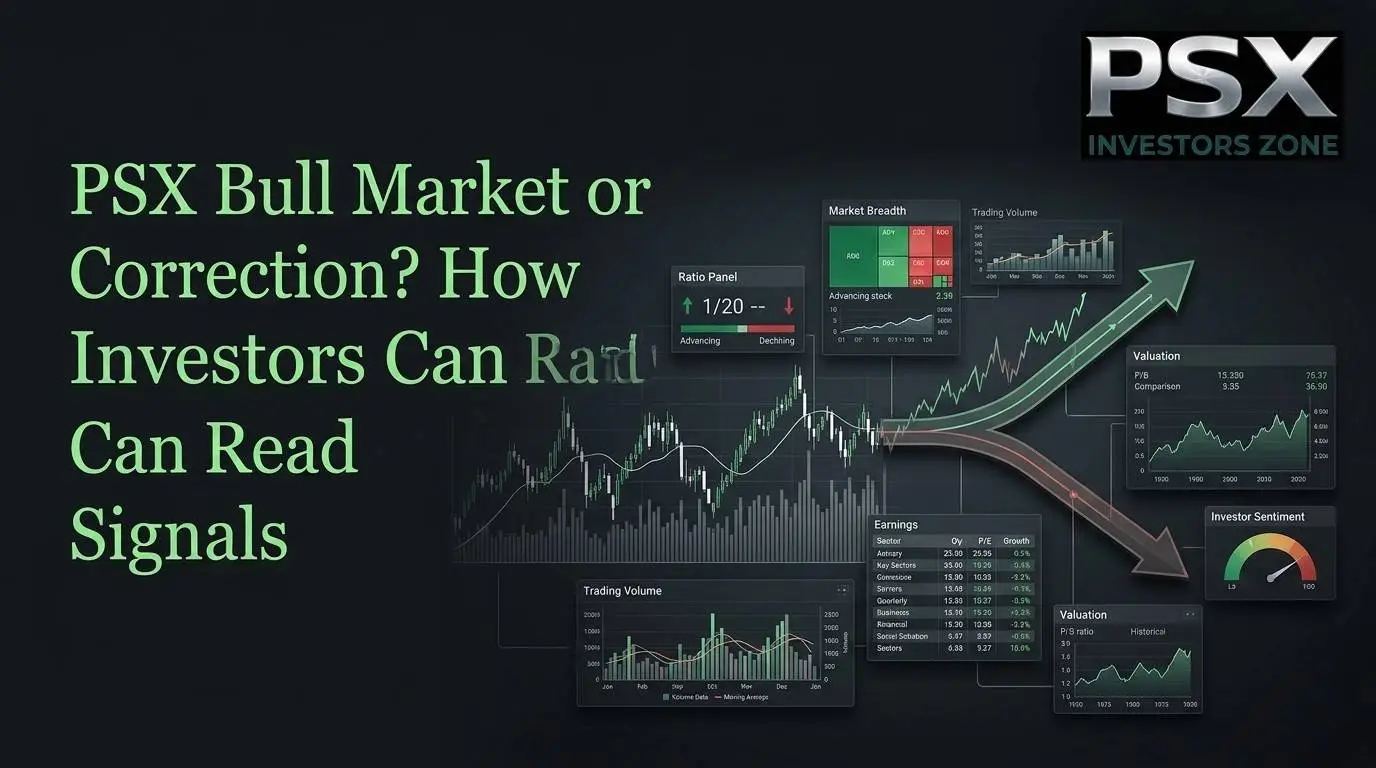
Introduction
The Pakistan Stock Exchange can move sharply in both directions.
After a strong rally, investors may wonder whether the market is entering a sustainable bull market or simply approaching a correction. When prices fall, the opposite question arises: is the decline a temporary pullback or the beginning of a larger downtrend?
These questions cannot be answered by looking at the KSE-100 Index alone.
A disciplined investor should analyze multiple market signals, including:
- Market trend
- Trading volume
- Market breadth
- Corporate earnings
- Valuations
- Foreign investment flows
- Interest rates
- Inflation
- Economic growth
- Investor sentiment
The objective is not to predict every market move.
Instead, investors should learn how to distinguish short-term market noise from meaningful changes in market fundamentals and trend.
Important: This article is for educational purposes only and does not predict future PSX performance or recommend any specific stock.
What Is a Bull Market?
A bull market generally refers to a sustained period of rising asset prices accompanied by improving investor confidence and, ideally, supportive fundamentals.
In the PSX context, a healthy bullish environment may involve:
- Rising major indices
- Improving corporate earnings
- Strong market breadth
- Healthy trading activity
- Positive investor sentiment
- Improving economic conditions
- Attractive or reasonable valuations
However, a rising index alone does not prove that the market is fundamentally strong.
A market can rise because valuations expand even while earnings remain weak.
Therefore:
Price trend + Fundamentals = More meaningful market signal
What Is a Market Correction?
A correction is a decline in prices after a period of appreciation.
Corrections can happen because investors:
- Take profits
- React to economic news
- Reassess valuations
- Respond to political uncertainty
- React to global market movements
- Reduce risk exposure
A correction does not automatically mean that a bull market has ended.
For long-term investors, the important question is:
Has the underlying investment thesis changed, or have prices simply pulled back?
Bull Market vs Correction: The Key Difference
A useful way to think about the difference is:
Bull Market
Prices rising + improving fundamentals + broad participation
Healthy Correction
Prices temporarily declining + fundamentals remaining relatively strong
Potential Trend Reversal
Prices declining + earnings weakening + market breadth deteriorating + economic conditions worsening
No single indicator can reliably identify these conditions.
Investors should look for confirmation across multiple signals.
1. Analyze the KSE-100 Trend
The KSE-100 is one of the most widely followed benchmarks for the Pakistan Stock Exchange.
Start by examining:
- Higher highs
- Higher lows
- Lower highs
- Lower lows
- Major support levels
- Major resistance levels
- Long-term trend direction
A market making a series of higher highs and higher lows generally indicates stronger upward momentum.
Conversely, repeated lower highs and lower lows can indicate weakening momentum.
But technical price patterns should be combined with fundamental analysis.
2. Look at Market Breadth
Market breadth measures how widely a market move is distributed across stocks.
For example, suppose the KSE-100 rises 3%.
If only a handful of large companies are responsible for most of the increase, the rally may be less broad than it appears.
But if many stocks across different sectors are participating, the market move may have stronger breadth.
Useful breadth indicators include:
- Advancing stocks
- Declining stocks
- New highs
- New lows
- Sector participation
Why Breadth Matters
A healthy market rally generally has participation beyond just a few index-heavy companies.
Therefore:
Index rising + broad participation = stronger signal
3. Analyze Trading Volume
Price tells you what happened.
Volume can provide additional information about participation.
Look for:
- Rising prices with increasing volume
- Rising prices with declining volume
- Falling prices with increasing volume
- Falling prices with declining volume
A price breakout supported by stronger trading activity can be more meaningful than a breakout occurring on unusually weak volume.
However, volume should not be interpreted in isolation.
Large transactions, institutional activity and market-specific factors can influence daily volume.
4. Examine Corporate Earnings
For long-term investors, earnings are among the most important market signals.
Ask:
Are listed companies actually becoming more profitable?
Analyze:
- Revenue growth
- EPS growth
- Profit margins
- ROE
- Cash flow
- Dividend capacity
A sustained bull market supported by improving corporate earnings can be fundamentally stronger than one driven primarily by valuation expansion.
5. Watch Market Valuations
A rising market can eventually become expensive.
Important valuation measures include:
P/E Ratio
Price ÷ Earnings Per Share
P/B Ratio
Market Price ÷ Book Value Per Share
Dividend Yield
Annual Dividend Per Share ÷ Share Price × 100
Compare current valuations with:
- Historical PSX averages
- Individual company history
- Sector averages
- Regional markets
A market can continue rising even when valuations become expensive.
The question is whether future earnings growth can justify those valuations.
6. Monitor Foreign Investor Flows
Foreign portfolio investment can provide another useful market signal.
Monitor:
- Foreign buying
- Foreign selling
- Monthly net flows
- Sector allocation
- Institutional participation
But avoid assuming:
Foreign buying = market must rise
Foreign investors can buy selected stocks while selling others.
Likewise, one month of foreign selling does not necessarily mean the entire market is fundamentally weak.
Look for persistent trends rather than isolated daily movements.
7. Watch Interest Rates
SBP monetary policy can significantly influence the investment environment.
Interest rates affect:
- Borrowing costs
- Corporate profitability
- Consumer financing
- Bank earnings
- Valuation multiples
- Investor preferences
Lower rates can potentially support economically sensitive sectors and equity valuations.
Higher rates can increase the attractiveness of fixed-income investments and raise financing costs.
But the impact varies by sector.
8. Monitor Inflation
Inflation affects both companies and investors.
High inflation can:
- Increase operating costs
- Reduce consumer purchasing power
- Increase interest rates
- Affect corporate margins
However, some companies have stronger pricing power and may pass increased costs to customers.
Therefore, investors should analyze:
Inflation + Company Pricing Power + Margin Trends
rather than assuming inflation affects every company equally.
9. Follow the Pakistani Rupee
Currency movements can influence PSX companies differently.
A weaker rupee can hurt businesses dependent on imported inputs.
But companies with substantial export or foreign-currency revenues may benefit from currency depreciation.
Analyze:
- Import exposure
- Export revenue
- Foreign-currency debt
- Raw-material costs
- Pricing power
Currency direction should therefore be evaluated at the company level.
10. Watch Economic Growth
Corporate earnings ultimately depend on economic activity.
Monitor indicators such as:
- GDP growth
- Industrial production
- Private-sector credit
- Consumer spending
- Construction activity
- Agricultural performance
- Export growth
Improving economic activity can create a supportive environment for cyclical sectors.
How to Recognize a Healthy Bull Market
No market signal is perfect, but several factors together can provide stronger confirmation.
A potentially healthy bull-market environment may show:
- KSE-100 trending upward
- Broad participation
- Healthy trading activity
- Improving corporate earnings
- Reasonable valuations
- Positive economic indicators
- Stable or improving currency conditions
- Supportive monetary conditions
- Continued institutional participation
The more of these signals align, the stronger the overall picture becomes.
How to Recognize a Potential Correction
A correction may become more likely when:
- Valuations become stretched
- Short-term speculation increases
- Market breadth weakens
- Trading becomes extremely volatile
- Investors aggressively take profits
- Index momentum deteriorates
But a correction by itself is not necessarily bearish.
A strong market can experience multiple corrections during a long-term uptrend.
When a Correction Becomes More Concerning
Investors should pay closer attention when several negative signals appear together.
For example:
Declining Prices + Weak Breadth + Falling Earnings + Expensive Valuations + Weak Economic Data
This combination is more concerning than:
Declining Prices + Strong Earnings + Reasonable Valuations + Healthy Economic Data
The difference is crucial.
Market Correction vs Bear Market
These terms are often confused.
Correction
A temporary decline within a broader market uptrend.
Bear Market
A prolonged period of significant weakness accompanied by deteriorating sentiment and fundamentals.
There is no single indicator that perfectly identifies the transition.
For long-term investors, focusing on fundamentals rather than trying to label every short-term decline can be more productive.
Sector Rotation Can Reveal Market Direction
Sometimes the overall index does not tell the complete story.
Money can rotate between sectors.
For example:
Banks → Energy → Cement → Technology → Consumer
Investors should monitor whether participation is expanding or narrowing.
A rally involving several economically important sectors can indicate broader market strength.
A rally concentrated in only a few stocks deserves more careful analysis.
The Role of Investor Sentiment
Markets are influenced by expectations.
Investors may become optimistic because of:
- Falling interest rates
- Economic reforms
- Improving earnings
- Foreign buying
- Political stability
- Strong corporate results
They may become pessimistic because of:
- Political uncertainty
- Geopolitical tensions
- Inflation
- Currency weakness
- Economic concerns
- Weak corporate earnings
Sentiment can push prices ahead of fundamentals.
Eventually, earnings and cash flows must support valuations.
Don't Confuse Price Momentum With Fundamental Strength
One of the most important lessons for investors is:
A rising stock is not necessarily a strong company.
Similarly:
A falling stock is not necessarily a weak company.
Always investigate:
- Earnings
- Debt
- Cash flow
- Competitive position
- Valuation
- Future growth
This is particularly important during periods of high market excitement.
A Simple PSX Market Signal Scorecard
Investors can create a simple scorecard:
| Signal | Bullish | Neutral | Concerning |
|---|---|---|---|
| Index Trend | Higher highs | Sideways | Lower lows |
| Breadth | Broad | Mixed | Narrow |
| Volume | Healthy | Normal | Weak |
| Earnings | Improving | Stable | Declining |
| Valuation | Reasonable | Moderate | Stretched |
| Foreign Flows | Sustained buying | Mixed | Sustained selling |
| Interest Rates | Supportive | Neutral | Restrictive |
| Inflation | Improving | Stable | Rising |
| Currency | Stable | Mixed | Weakening |
| Economic Growth | Improving | Stable | Weakening |
This is not a prediction model.
It is simply a framework for organizing market information.
A Practical 5-Step Process for PSX Investors
Step 1: Check the Market Trend
Look at the KSE-100 and broader market direction.
Step 2: Check Breadth
Determine whether many stocks are participating.
Step 3: Check Fundamentals
Review corporate earnings and economic indicators.
Step 4: Check Valuations
Ask whether prices are justified by earnings and future growth.
Step 5: Check Risk
Identify the factors that could invalidate your investment thesis.
This process is more reliable than making decisions based on a single headline.
What Should Long-Term Investors Do During a Correction?
Long-term investors should avoid automatically treating every market decline as a crisis.
Instead:
Review Your Holdings
Ask whether company fundamentals have changed.
Recheck Valuations
A lower share price can change the risk-reward relationship.
Maintain Discipline
Avoid emotional decisions based on short-term market movements.
Keep Cash Management in Mind
Do not invest money you may need in the short term.
Focus on Quality
Strong businesses with sustainable earnings may deserve greater attention than highly speculative stocks.
Shariah-Compliant Investors: An Additional Check
For investors following Shariah-compliant principles, market analysis requires an additional filter.
A stock should not be considered suitable simply because:
- Its price is rising
- Foreign investors are buying it
- Its dividend yield is high
- It belongs to a popular sector
Investors should also verify:
- Business activity
- Shariah screening status
- Financial ratios
- Applicable screening methodology
- Latest available compliance information
Shariah status can change, so current information should always be checked before making an investment decision.
Common Mistakes During Market Rallies
Chasing Stocks After Large Gains
A strong recent return does not automatically mean future returns will remain strong.
Buying Because Everyone Is Bullish
Popular sentiment can already be reflected in prices.
Ignoring Valuation
A great company can become an expensive investment.
Using Only Technical Analysis
Charts can help understand market behavior, but fundamental investors should also analyze the underlying business.
Selling Everything During a Correction
A correction does not automatically mean the long-term thesis has failed.
Trying to Predict the Exact Top or Bottom
Markets are difficult to time precisely.
Key Takeaways
- A rising KSE-100 does not automatically mean the market is fundamentally strong.
- A market correction does not automatically mean a bear market has started.
- Market breadth helps determine whether a rally is broad or concentrated.
- Trading volume can provide additional confirmation of market participation.
- Corporate earnings are critical for evaluating long-term market strength.
- Valuation matters even during strong bull markets.
- Foreign investor flows can provide useful context but should not be treated as a standalone buy or sell signal.
- Interest rates, inflation, currency movements and economic growth can influence PSX performance.
- Sector rotation can reveal changes in investor preferences.
- Long-term investors should distinguish between temporary price volatility and fundamental deterioration.
- Shariah-conscious investors should verify the current compliance status of individual companies.
- The strongest approach is to combine price action + breadth + volume + fundamentals + valuation + macroeconomic signals.
Frequently Asked Questions
How can I tell if PSX is in a bull market?
Look for sustained upward price trends, broad market participation, healthy trading activity, improving earnings, supportive economic conditions and reasonable valuations. No single indicator can confirm a bull market.
What is a PSX market correction?
A correction is a decline in stock prices following a period of gains. A correction can occur within a broader long-term uptrend and does not necessarily indicate a bear market.
Is a market correction a good time to buy PSX stocks?
It can create opportunities when quality companies become more reasonably valued, but investors should first determine whether the decline is temporary or caused by deteriorating fundamentals.
Should I sell when the KSE-100 falls sharply?
Not automatically. Investors should review the fundamentals and valuation of individual holdings before making decisions based solely on index movements.
Does high trading volume mean the market will rise?
No. High volume indicates greater trading activity but does not determine direction. It should be analyzed alongside price movement and other market signals.
Does foreign buying mean PSX will rise?
Not necessarily. Foreign flows can provide useful information about international investor sentiment, but they do not guarantee future market performance.
Which indicators should PSX investors watch?
Useful indicators include the KSE-100 trend, market breadth, trading volume, corporate earnings, valuations, foreign flows, interest rates, inflation, currency movements and economic growth.
Should Shariah-compliant investors use market signals?
Yes, but market signals should be combined with Shariah screening. A rising stock or strong market trend does not determine whether a company is Shariah-compliant.
Conclusion
Determining whether the Pakistan Stock Exchange is entering a bull market or experiencing a correction requires more than looking at whether the KSE-100 is rising or falling.
Investors should build a broader picture:
Market Trend → Breadth → Volume → Earnings → Valuation → Foreign Flows → Interest Rates → Economy
When several signals point in the same direction, investors can have greater confidence in their market assessment.
But no framework can predict the market perfectly.
For long-term PSX investors, the better objective is not to predict every short-term move. It is to identify quality businesses, understand valuation, manage risk, and remain disciplined when market sentiment changes.
Educational Disclaimer: This article is for educational purposes only and does not constitute financial, investment, legal, tax, or Shariah advice. Market conditions can change rapidly, and no indicator guarantees future performance. Investing in the Pakistan Stock Exchange involves risk, including possible loss of capital. Always conduct your own research and verify the latest market and company information before making investment decisions.