Margin of Safety Explained: The Secret to Smarter PSX Investing
Every investor wants to buy quality companies at attractive prices. However, no valuation method is perfectly accurate, and no one can predict the future with complete certainty.
This is where one of the most important concepts in value investing comes into play—the Margin of Safety.
Popularized by Benjamin Graham, the father of value investing, the Margin of Safety helps investors reduce risk by purchasing stocks at a price below their estimated intrinsic value.
Instead of chasing market trends, disciplined investors focus on buying businesses with a cushion against uncertainty.
At PSX Investors Zone, we believe that understanding the Margin of Safety can help investors make more confident, research-based decisions in the Pakistan Stock Exchange (PSX).
What Is Margin of Safety?
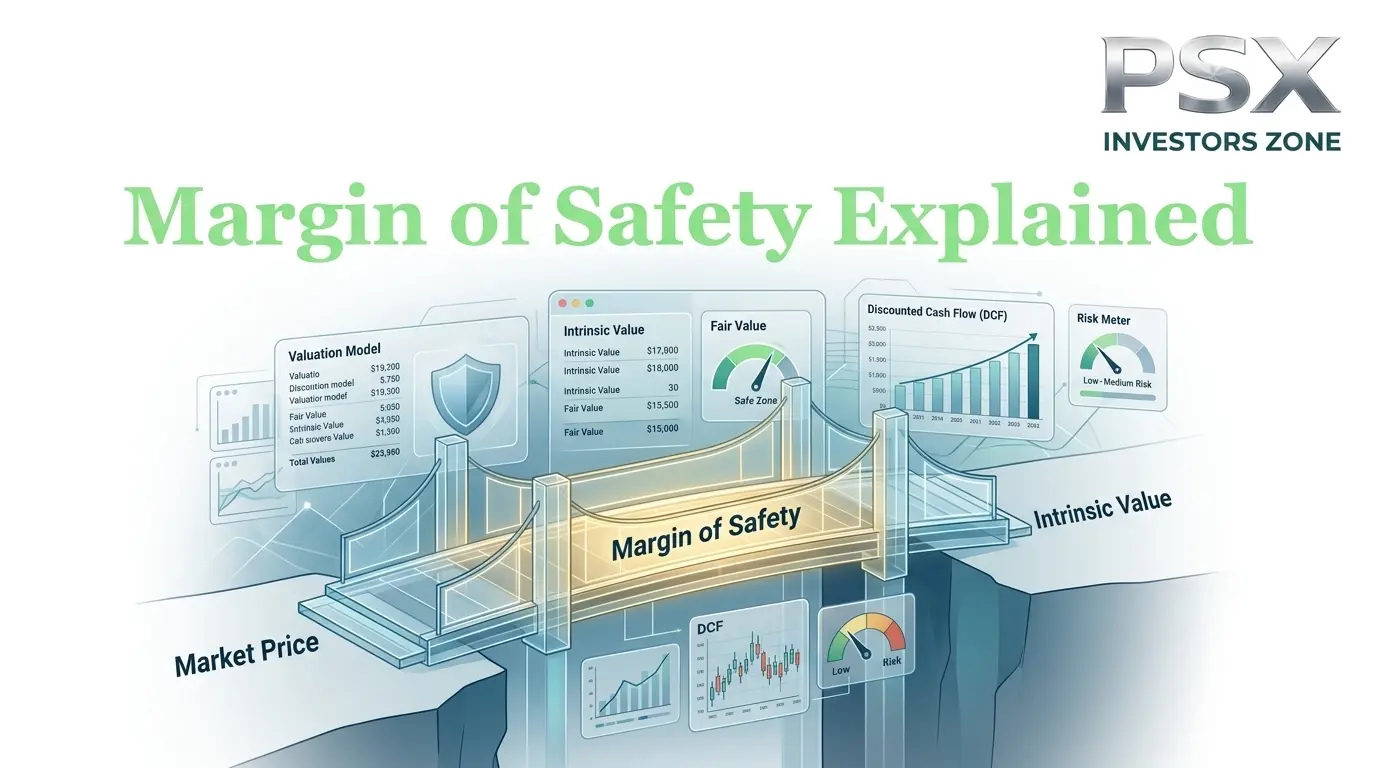
The Margin of Safety is the difference between a stock's Intrinsic Value and its Current Market Price.
In simple words:
Margin of Safety means buying a stock for less than what you believe it is truly worth.
The larger the discount between market price and intrinsic value, the greater the potential margin of safety.
Margin of Safety Formula
Formula
Margin of Safety (%) = ((Intrinsic Value − Market Price) ÷ Intrinsic Value) × 100
Example
Suppose:
- Estimated Intrinsic Value = Rs. 200
- Current Market Price = Rs. 160
Calculation:
((200 − 160) ÷ 200) × 100 = 20%
This means the investor is buying the stock with a 20% Margin of Safety.
Why Is Margin of Safety Important?
The future is uncertain.
Even the best investors can make mistakes when estimating a company's intrinsic value.
A Margin of Safety helps protect investors against:
- Valuation errors
- Unexpected business challenges
- Economic downturns
- Market volatility
- Temporary declines in company earnings
Rather than relying on perfect predictions, investors create room for error.
Why Professional Investors Use Margin of Safety
Successful long-term investors understand that preserving capital is just as important as earning returns.
Buying below intrinsic value may:
- Reduce downside risk.
- Improve long-term investment returns.
- Provide greater confidence during market volatility.
- Encourage disciplined investing.
- Reduce emotional decision-making.
Margin of Safety vs Market Timing
Many beginners try to predict the perfect time to buy.
Professional investors often focus on value instead.
| Market Timing | Margin of Safety |
|---|---|
| Predicts short-term price movements | Focuses on long-term business value |
| Influenced by market sentiment | Based on financial analysis |
| Difficult to predict consistently | Encourages disciplined investing |
The Margin of Safety is based on business fundamentals rather than short-term price fluctuations.
How Do Investors Estimate Margin of Safety?
Before calculating the Margin of Safety, investors estimate a company's intrinsic value by analyzing:
- Earnings Per Share (EPS)
- Return on Equity (ROE)
- Return on Assets (ROA)
- Free Cash Flow (FCF)
- Book Value Per Share (BVPS)
- Debt-to-Equity Ratio
- Current Ratio
- Revenue Growth
- Profit Margins
- Future Growth Prospects
The more comprehensive the analysis, the more meaningful the Margin of Safety.
Is a Bigger Margin of Safety Always Better?
Generally, a larger Margin of Safety provides greater protection.
However, investors should also ask:
- Why is the stock trading below intrinsic value?
- Are there business risks?
- Has profitability declined?
- Is the industry facing challenges?
A low share price alone does not make a stock a good investment.
Practical Example
Imagine two companies with an estimated intrinsic value of Rs. 250.
| Company | Market Price | Margin of Safety |
|---|---|---|
| Company A | Rs. 225 | 10% |
| Company B | Rs. 175 | 30% |
Assuming both companies have similar financial strength, Company B offers a larger Margin of Safety.
However, investors should still evaluate the quality of the business before investing.
Common Mistakes Investors Make
Confusing Cheap Stocks with Good Value
A low-priced stock is not necessarily undervalued.
Always compare market price with intrinsic value.
Ignoring Company Fundamentals
A weak company does not become a good investment simply because its share price has fallen.
Relying on One Financial Ratio
Margin of Safety should be supported by comprehensive financial analysis.
Chasing Market Hype
Buying stocks based solely on market excitement often leads to poor investment decisions.
Financial Metrics to Review Alongside Margin of Safety
Use the Margin of Safety together with:
- Intrinsic Value
- Free Cash Flow (FCF)
- Earnings Per Share (EPS)
- Return on Equity (ROE)
- Return on Assets (ROA)
- Price-to-Earnings (P/E) Ratio
- Price-to-Book (P/B) Ratio
- Book Value Per Share (BVPS)
- Debt-to-Equity Ratio
- Current Ratio
Using multiple financial indicators helps investors make more balanced decisions.
How PSX Investors Zone Helps Investors
At PSX Investors Zone, we publish practical educational content covering:
- Value Investing
- Fundamental Analysis
- Company Valuation
- Financial Ratios
- Financial Statements
- Long-Term Investing
- Risk Management
- Dividend Investing
- Shariah-Compliant Investing
Our mission is to help investors understand businesses, evaluate risk, and make informed investment decisions through education and research.
Key Takeaways
- Margin of Safety is the difference between intrinsic value and market price.
- Buying below intrinsic value helps reduce investment risk.
- Margin of Safety protects investors from valuation errors and market uncertainty.
- A low share price alone does not indicate a good investment.
- Always combine Margin of Safety with comprehensive company analysis.
Frequently Asked Questions
What is Margin of Safety?
Margin of Safety is the percentage difference between a stock's estimated intrinsic value and its current market price.
Why is Margin of Safety important?
It helps reduce investment risk by providing a cushion against valuation errors and unexpected business challenges.
Is a larger Margin of Safety always better?
Generally, yes. However, investors should also ensure the company has strong financial fundamentals.
Who introduced the Margin of Safety concept?
The concept was popularized by Benjamin Graham, widely regarded as the father of value investing.
Should beginners use Margin of Safety?
Yes. It encourages disciplined investing and helps investors avoid overpaying for stocks.
Conclusion
The Margin of Safety is one of the most valuable principles in long-term investing because it combines disciplined valuation with risk management.
Rather than trying to predict short-term market movements, investors focus on identifying quality businesses trading below their estimated intrinsic value. While no valuation method is perfect, purchasing stocks with an appropriate Margin of Safety can help reduce risk and improve long-term decision-making.
By combining this concept with fundamental analysis, financial ratios, and careful research, investors can approach the Pakistan Stock Exchange with greater confidence and discipline.
Educational Disclaimer: This article is for educational purposes only and does not constitute financial, investment, legal, tax, or Shariah advice. Investing in the Pakistan Stock Exchange involves risk, including the possible loss of capital. Always conduct your own research and consult qualified professionals before making investment decisions.