PSX Sector Analysis 2026: Which Sectors Should Investors Watch?
Introduction
The Pakistan Stock Exchange does not move as one single market.
Different sectors respond differently to interest rates, inflation, economic growth, commodity prices, exchange rates, government policies, consumer demand, and global economic conditions.
That is why sector analysis can be an important part of fundamental investing.
Instead of asking only:
"Which PSX stock should I buy?"
investors can first ask:
"Which sectors have improving fundamentals, attractive valuations, and favorable economic conditions?"
This approach can help investors narrow the market into a more manageable group of companies for deeper research.
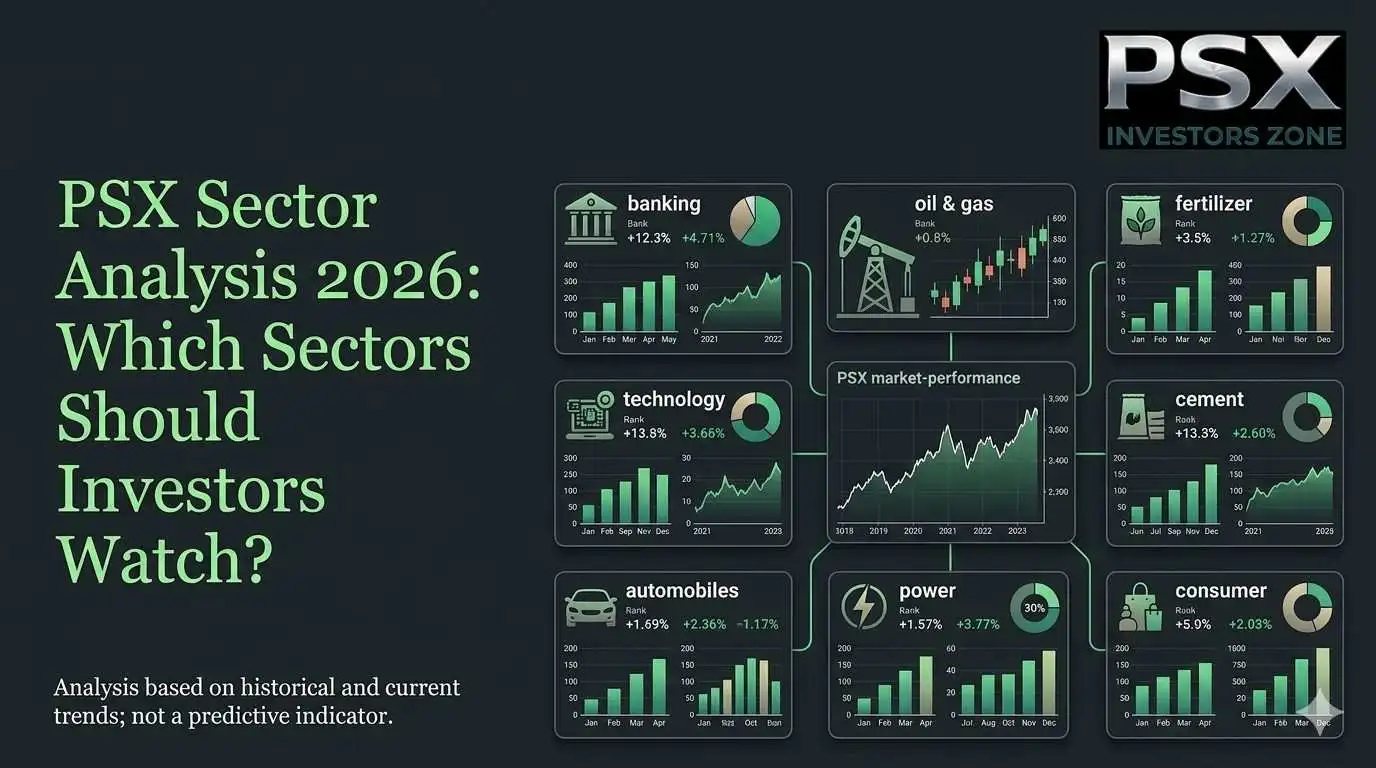
For 2026, important PSX sectors to monitor include commercial banks, oil and gas, fertilizer, cement, technology, automobiles, power, and consumer-related companies.
PSX data and government economic reports show that commercial banks, oil and gas exploration, cement, fertilizer, food/personal care, and other major sectors represent substantial portions of Pakistan's listed equity market. :contentReference[oaicite:0]{index=0}
Important: This article is an educational sector-analysis framework, not a prediction or recommendation to buy any particular stock.
Why Sector Analysis Matters for PSX Investors
A company's performance is often influenced by the industry in which it operates.
For example:
- Banks are sensitive to interest rates and credit conditions.
- Cement companies depend heavily on construction activity and energy costs.
- Oil and gas companies are affected by commodity prices and production.
- Fertilizer companies depend on agricultural demand, pricing, and gas availability.
- Technology companies can benefit from export growth and currency movements.
- Automobile companies are sensitive to consumer demand and financing conditions.
- Power companies depend on tariffs, receivables, fuel costs, and regulatory developments.
Therefore, understanding the sector can provide important context before analyzing an individual company.
The 8 PSX Sectors Investors Should Watch in 2026
1. Commercial Banks
Banking is one of the most important sectors in the Pakistani equity market.
Pakistan's Economic Survey reported that commercial banks represented approximately 25.13% of total market capitalization during July–March FY2026, making them the largest sector in the reported top-five sector breakdown. :contentReference[oaicite:1]{index=1}
What Drives Banks?
Investors should monitor:
- SBP policy rates
- Net interest margins
- Deposit growth
- Loan growth
- Government securities
- Non-performing loans
- Provisioning
- Capital adequacy
- Dividend distributions
- Islamic banking growth
Why Watch Banking in 2026?
Interest-rate movements can significantly affect banking profitability and investor expectations.
At the same time, banks are highly exposed to Pakistan's economic and fiscal environment.
The key question is not simply whether interest rates are rising or falling.
Investors should ask:
How will changing rates affect this particular bank's margins, deposits, loans, and investment portfolio?
2. Oil & Gas Exploration
Energy remains a major component of the Pakistani market.
Oil and gas exploration companies can be influenced by:
- Global crude oil prices
- Domestic production
- Exploration success
- Foreign exchange
- Energy policy
- Circular debt
- Government pricing
- Receivables
Pakistan's Economic Survey reported oil and gas exploration companies at approximately 15.93% of total market capitalization during July–March FY2026. :contentReference[oaicite:2]{index=2}
What Investors Should Watch
Pay particular attention to:
- Production volumes
- Oil and gas prices
- New discoveries
- Development costs
- Receivables
- Circular-debt developments
- Dividend capacity
Energy stocks can behave differently from other sectors because commodity-price movements can have a significant impact on earnings expectations.
3. Fertilizer
The fertilizer sector is another major area for PSX investors to monitor.
Agriculture is critical to Pakistan's economy, making fertilizer demand an important consideration.
Key Drivers
Watch:
- Fertilizer prices
- Gas availability
- Gas pricing
- Crop economics
- Agricultural demand
- Government policies
- Import requirements
- Company production capacity
- Dividend policies
The fertilizer sector represented approximately 7.83% of market capitalization during July–March FY2026 according to Pakistan's Economic Survey. :contentReference[oaicite:3]{index=3}
Why It Matters
Fertilizer companies can sometimes offer a combination of:
Earnings visibility + defensive characteristics + dividends
But investors should still evaluate valuation and company-specific risks rather than treating the entire sector as identical.
4. Cement
Cement is closely linked to construction and economic activity.
The sector can be affected by:
- Construction demand
- Housing activity
- Infrastructure spending
- Interest rates
- Coal prices
- Energy costs
- Cement prices
- Domestic dispatches
- Export demand
Recent PSX-sector data showed cement among the sectors contributing materially to market performance, while industry data indicated improving dispatch and earnings trends during FY2026. :contentReference[oaicite:4]{index=4}
What Makes Cement Interesting?
If economic activity and construction improve, cement demand can potentially benefit.
However, investors should carefully monitor:
Volumes + Prices + Costs + Margins
A rise in sales volume does not automatically translate into higher profits if energy or raw-material costs increase sharply.
5. Technology & Communication
Technology has become increasingly important within Pakistan's listed market.
Technology companies can benefit from:
- IT exports
- Global technology demand
- Digital transformation
- Foreign-currency revenues
- Software services
- International clients
- Productivity improvements
Pakistan's Economic Survey reported technology and communication among the sectors showing substantial market-capitalization growth during FY2026. :contentReference[oaicite:5]{index=5}
Key Risks
Technology investors should also consider:
- Global IT demand
- Client concentration
- Currency movements
- Wage inflation
- Competition
- Global recession risks
- Valuation
Technology stocks can trade at higher valuations because investors expect stronger growth.
Therefore:
Growth must be compared with valuation.
6. Automobile
The automobile sector is closely connected to consumer purchasing power and economic conditions.
Monitor:
- Vehicle sales
- Production volumes
- Auto financing
- Interest rates
- Consumer confidence
- Import restrictions
- Currency movements
- New model launches
- Raw-material costs
When financing conditions improve and consumer confidence strengthens, automobile demand can potentially recover.
However, this sector is highly cyclical.
Investors should avoid assuming that a recovery in sales automatically makes every automobile stock attractive.
7. Power Generation & Distribution
The power sector is important but requires careful analysis because its financial performance can be heavily influenced by regulation and receivables.
Key factors include:
- Electricity tariffs
- Circular debt
- Fuel costs
- Government policy
- Receivables
- Capacity payments
- Regulatory decisions
- Interest costs
Pakistan's Economic Survey reported power generation and distribution among the sectors that increased in market capitalization during FY2026. :contentReference[oaicite:6]{index=6}
What Investors Should Ask
Before investing in a power company, understand:
How does the company generate revenue?
How quickly does it collect receivables?
What regulatory framework applies?
How exposed is it to circular-debt issues?
8. Food, Consumer & Personal Care
Consumer-oriented businesses can provide exposure to domestic consumption.
These companies may be influenced by:
- Population growth
- Household income
- Inflation
- Consumer purchasing power
- Brand strength
- Distribution networks
- Pricing power
The food and personal-care sector represented approximately 7.70% of market capitalization during July–March FY2026, according to the Pakistan Economic Survey. :contentReference[oaicite:7]{index=7}
Why Watch Consumer Companies?
Strong brands can sometimes pass higher costs to consumers.
But persistent inflation can also reduce purchasing power.
Investors therefore need to examine:
Volume growth + Price increases + Margins + Consumer demand
How Interest Rates Affect Different PSX Sectors
Interest rates do not affect all sectors equally.
| Sector | Typical Key Sensitivity |
|---|---|
| Banks | Interest rates, deposits, credit |
| Cement | Construction, financing, energy |
| Automobiles | Consumer financing, demand |
| Technology | Growth expectations, valuation |
| Fertilizer | Agriculture, gas costs |
| Oil & Gas | Commodity prices, currency |
| Power | Financing, tariffs, receivables |
| Consumer | Purchasing power, inflation |
This is why investors should connect macro conditions with sector fundamentals.
How to Analyze PSX Sector Rotation
Sector rotation occurs when investors shift capital from one group of companies to another.
For example, investors may favor:
Banks → Cyclicals → Technology → Defensive sectors
depending on economic expectations.
But sector rotation should not be interpreted simply from short-term price movements.
Instead, examine:
- Earnings revisions
- Trading volume
- Valuation changes
- Economic indicators
- Interest-rate expectations
- Corporate results
- Investor flows
PSX's own quarterly newsletter tracks sector contributions to the KSE-100 and KMI-30, demonstrating how different sectors can materially affect index performance. :contentReference[oaicite:8]{index=8}
Sector Performance Is Not the Same as Future Potential
One of the biggest mistakes investors make is assuming:
"This sector performed well, so it will perform well again."
That is not necessarily true.
A sector can rise because:
- Earnings improved
- Valuations expanded
- Interest rates changed
- Investor expectations improved
- A major policy announcement occurred
Once those expectations are already reflected in stock prices, future returns may be different.
Therefore, always ask:
What is already priced into the stock?
How to Compare PSX Sectors
A simple sector-analysis framework can use five categories.
1. Earnings
Are sector earnings:
- Growing?
- Stable?
- Declining?
2. Valuation
Compare:
- P/E
- P/B
- Dividend yield
- Historical valuation
3. Economic Sensitivity
Determine whether the sector benefits from:
- Lower interest rates
- Higher economic growth
- Stronger currency
- Higher commodity prices
- Increased consumer demand
4. Balance-Sheet Strength
Look at:
- Debt
- Cash
- Liquidity
- Interest obligations
5. Future Catalysts
Identify potential catalysts such as:
- Policy changes
- New projects
- Capacity expansion
- Export growth
- Lower input costs
- Economic recovery
A Simple PSX Sector Scorecard
Investors can create a scorecard before selecting individual stocks.
| Factor | Question |
|---|---|
| Earnings | Are profits improving? |
| Revenue | Is demand growing? |
| Margins | Are margins stable? |
| Valuation | Is the sector reasonably priced? |
| Debt | Is financial risk manageable? |
| Cash Flow | Is cash generation healthy? |
| Dividend | Are distributions sustainable? |
| Catalyst | What could improve performance? |
| Risk | What could hurt the sector? |
| Shariah | Is the company currently compliant? |
This helps turn sector research into a repeatable process.
Which PSX Sectors Look Most Interesting in 2026?
Rather than declaring one sector the "best," investors should watch different sectors for different reasons.
Banking
Watch for: Interest-rate changes, profitability, deposits, credit growth and dividends.
Oil & Gas
Watch for: Oil prices, production, receivables and energy policy.
Fertilizer
Watch for: Agricultural demand, gas pricing, fertilizer prices and dividends.
Cement
Watch for: Construction activity, dispatches, pricing and coal costs.
Technology
Watch for: IT exports, global demand, earnings growth and valuations.
Automobile
Watch for: Vehicle sales, financing, consumer demand and production.
Power
Watch for: Tariffs, receivables, circular debt and regulation.
Consumer
Watch for: Pricing power, volume growth, inflation and purchasing power.
The "best" sector depends on the combination of fundamentals, valuation, catalysts, and risk.
Shariah-Compliant Sector Analysis
For investors who follow Shariah-compliant investing, sector analysis requires an additional layer.
A sector may contain both compliant and non-compliant companies.
Therefore, do not assume that an entire sector is Shariah-compliant.
Before investing, verify:
- Business activity
- Current Shariah status
- Applicable screening methodology
- Financial screening criteria
- Latest screening date
PSX maintains Shariah-compliant investment resources and Islamic market indices that can be used as starting points for research.
Because screening methodologies and company classifications can change, investors should always verify current information.
How to Turn Sector Analysis Into Stock Research
Once you identify an interesting sector, move from:
Sector → Industry → Company → Financial Statements → Valuation → Risk
For example:
Step 1
Identify a sector with improving fundamentals.
Step 2
Compare companies within that sector.
Step 3
Review revenue and earnings growth.
Step 4
Analyze ROE, margins and cash flow.
Step 5
Evaluate debt and financial strength.
Step 6
Compare P/E and P/B ratios.
Step 7
Study dividends.
Step 8
Read the annual report.
Step 9
Check current Shariah status if applicable.
Step 10
Determine whether the current price provides a reasonable margin of safety.
Common Sector-Investing Mistakes
Mistake 1: Chasing the Best-Performing Sector
Past performance does not guarantee future returns.
Mistake 2: Ignoring Valuation
A strong sector can become expensive.
Mistake 3: Treating All Companies as Equal
Two companies in the same sector can have very different financial quality.
Mistake 4: Ignoring Macro Factors
Interest rates, inflation, currency and commodity prices can change sector economics.
Mistake 5: Focusing Only on Headlines
Sector narratives can move faster than fundamentals.
Mistake 6: Ignoring Shariah Status
For Shariah-conscious investors, current compliance should be verified separately.
Mistake 7: Over-Concentrating
Being bullish on a sector does not necessarily mean your entire portfolio should depend on it.
PSX Sector Research Checklist for 2026
Before selecting a sector, ask:
Macro
- What is happening with SBP interest rates?
- Is inflation rising or falling?
- What is happening to the rupee?
- Is economic growth improving?
- What are global commodity prices doing?
Sector
- Are revenues growing?
- Are earnings improving?
- Are margins stable?
- Is demand increasing?
- Are input costs manageable?
- Is the sector fairly valued?
Company
- Which companies are the strongest?
- Which have the best balance sheets?
- Which have sustainable cash flow?
- Which have competitive advantages?
- Which valuations are reasonable?
Shariah
- Is the company currently Shariah-compliant?
- Has the latest screening information been checked?
Key Takeaways
- PSX sector analysis can help investors understand where opportunities and risks may be developing.
- Banking remains one of the largest sectors in Pakistan's listed market.
- Oil and gas is highly sensitive to energy prices and domestic energy conditions.
- Fertilizer can offer exposure to agricultural demand and potentially defensive earnings.
- Cement is closely linked to construction and economic activity.
- Technology provides exposure to IT exports and global technology demand.
- Automobile stocks are sensitive to consumer demand and financing conditions.
- Power companies require careful analysis of regulation, receivables and circular debt.
- Consumer companies depend heavily on purchasing power and pricing power.
- Sector performance should always be evaluated alongside valuation.
- Strong sector performance does not guarantee future outperformance.
- Investors should move from sector analysis to detailed company-level research.
- Shariah-conscious investors should verify the latest Shariah status of individual companies.
- The objective is not to predict the winning sector with certainty, but to identify sectors where fundamentals, valuation, catalysts and risk are reasonably aligned.
Frequently Asked Questions
Which PSX sectors should investors watch in 2026?
Important sectors to monitor include banking, oil and gas, fertilizer, cement, technology, automobiles, power and consumer-related companies. The appropriate focus depends on economic conditions, sector fundamentals and valuations.
Which sector is the biggest on PSX?
Commercial banks were the largest sector in the Pakistan Economic Survey's July–March FY2026 market-capitalization breakdown, accounting for approximately 25.13% of the total. :contentReference[oaicite:9]{index=9}
Is banking a good sector for PSX investors?
Banking can offer significant exposure to Pakistan's economy, but investors should analyze individual banks based on interest-rate sensitivity, deposits, loan growth, asset quality, profitability, valuation and dividends.
Which PSX sectors benefit from lower interest rates?
Banks, automobiles, cement and other economically sensitive sectors can respond to lower rates, but the effect varies by company and the broader economic environment.
Why is the cement sector important?
Cement demand is closely connected to construction, infrastructure and economic activity. Investors should monitor dispatch volumes, cement prices, energy costs, coal prices and profit margins.
Is the technology sector attractive in Pakistan?
Technology can offer significant growth potential through IT exports and international demand, but investors should also consider valuation, global technology conditions, currency movements and company-specific risks.
Should investors choose sectors or individual stocks?
Sector analysis can help narrow the investment universe, but individual companies should still be evaluated based on financial strength, earnings, valuation, management and risk.
How should Shariah-compliant investors analyze sectors?
First identify sectors and companies that meet applicable Shariah requirements, then perform normal fundamental analysis. Current Shariah status should always be verified because screening results and methodologies can change.
Conclusion
The PSX Sector Analysis 2026 should not be about finding one sector that is guaranteed to outperform.
A better approach is to understand how different sectors respond to Pakistan's economic environment.
Monitor:
Interest Rates → Inflation → Economic Growth → Currency → Commodities → Sector Earnings → Valuation → Company Fundamentals
Then move from the sector level to individual companies.
A sector with improving fundamentals can still contain expensive or weak companies. Likewise, a sector facing short-term challenges can contain businesses with strong long-term competitive advantages.
For long-term PSX investors, the goal should be to combine sector awareness with company-level fundamental analysis, sensible valuation, risk management and—where applicable—current Shariah screening.
Educational Disclaimer: This article is for educational purposes only and does not constitute financial, investment, legal, tax, or Shariah advice. Sector performance and market conditions can change rapidly. Nothing in this article guarantees future returns or recommends any specific security. Investing in PSX involves risk, including possible loss of capital. Always conduct your own research and verify current company, market and Shariah information before making investment decisions.